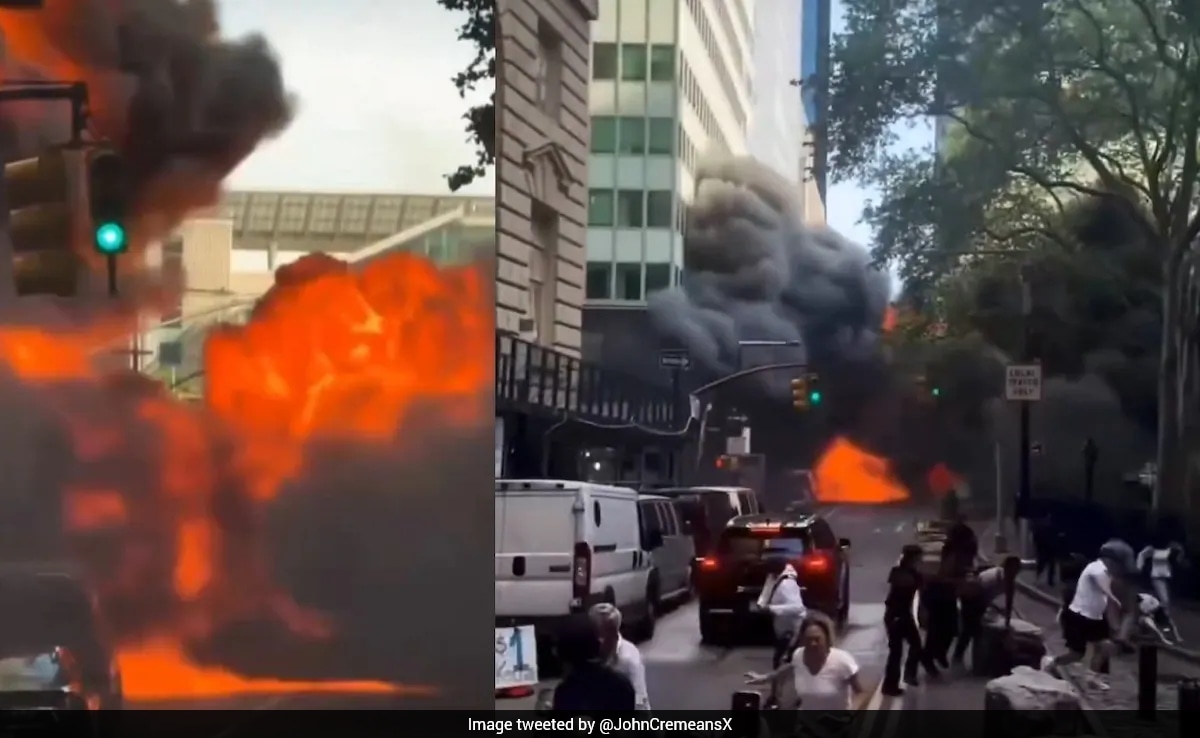
The convergence of high-density urban populations, aging metropolitan infrastructure, and evolving vehicular technologies creates a highly volatile risk profile for modern cities. When a vehicle combusts in a critical economic zone, such as the intersection near the iconic Charging Bull statue in Lower Manhattan, the event cannot be analyzed merely as an isolated traffic incident. Instead, it must be evaluated as a systemic disruption that tests the failure points of urban engineering, emergency response protocols, and localized economic continuity.
Analyzing an incident of this nature requires breaking down the event into three distinct analytical pillars: thermal dynamics and structural risk, logistical gridlock mechanics, and the economic friction coefficient of localized disruption. By mapping these vectors, municipal strategists and risk managers can move past sensationalized reporting and quantify the actual vulnerabilities exposed by sudden kinetic events in major financial hubs.
Thermal Dynamics and the Structural Risk Profile of Sub-Surface Infrastructure
A vehicular explosion in a dense urban environment presents an immediate thermal threat to both surrounding structures and sub-surface utility networks. Standard internal combustion engine (ICE) fires routinely reach temperatures between 800°C and 1,000°C. If the vehicle utilizes a lithium-ion battery powertrain, a thermal runaway event can elevate those temperatures to over 2,000°C, introducing a different set of chemical hazards and structural strains.
Lower Manhattan's geography features a dense matrix of subterranean infrastructure directly beneath the asphalt. This network includes high-voltage electrical conduits, fiber-optic telecommunications lines, water mains, and steam distribution systems.
Thermal Conduction Pathways
Asphalt acts as a semiconductor of heat. Prolonged exposure to localized temperatures exceeding 1,000°C initiates a process called raveling and structural deformation of the roadway. The heat radiates downward, threatening the protective shielding of utility vaults.
Vault Vulnerability
Many subterranean utility vaults rely on reinforced concrete and cast-iron access points. While concrete possesses low thermal conductivity, rapid and extreme temperature differentials cause spalling—a phenomenon where moisture trapped inside the concrete expands, causing the material to crack and break away, exposing structural steel rebar to structural failure.
Gas and Steam Dynamics
The proximity of high-pressure steam loops introduces a secondary risk variable. A sudden increase in external ambient temperature can alter the pressure equilibrium within these systems, increasing the probability of a secondary catastrophic rupture.
The primary objective of emergency response teams under this framework is not merely the suppression of visible flames, but the rapid cooling of the surrounding pavement to arrest the downward propagation of thermal energy. Failure to contain this thermal migration can result in multi-week utility outages that cripple localized corporate operations.
The Logistical Gridlock Mechanics of Lower Manhattan
The street layout of the Financial District is a historical artifact, characterized by narrow, non-grid corridors that limit vehicular maneuverability. When a vehicle catches fire near a focal node like Broadway or Morris Street, the geometric constraints of the roadway amplify the operational bottleneck.
[Incident Node: Vehicle Explosion]
       │
       ▼
[Immediate Blockage of Primary Corridor]
       │
       ▼
[Cascading Diversion to Sub-Standard Arteries]
       │
       ▼
[Total Network Saturation / First Responder Stagnation]
This structural reality produces a predictable cascading failure within the transit network, which operates via a clear cause-and-effect chain:
The Primary Blockage: A single burning vehicle completely occupies the effective width of a narrow historical street, halting all trailing traffic. Because these streets frequently lack shoulders or bypass lanes, vehicles behind the incident node are functionally trapped, preventing immediate evacuation.
The First Responder Bottleneck: Emergency apparatuses require wide turning radii and clear approach paths. In the narrow corridors of Lower Manhattan, trailing civilian traffic rapidly blocks the ingress routes for fire engines and hazardous material units. This creates a compounding delay where the time to first water application scales non-linearly with the duration of the traffic buildup.
Arterial Saturation: As municipal traffic management systems divert vehicles away from the incident node, adjacent secondary arteries (such as Church Street or Water Street) experience an immediate influx of volume that exceeds their designed carrying capacity. The resulting gridlock stalls surface-level public transit and delays courier networks.
To mitigate this logistical vulnerability, municipal frameworks must transition toward predictive, real-time arterial closure models. Rather than reacting to an incident after confirmation, traffic control systems must automatically restrict access to historical corridors the moment a critical incident is reported, preserving ingress paths for emergency assets.
The Economic Friction Coefficient of Localized Disruption
The proximity of an incident to global economic symbols, such as the Charging Bull, introduces a psychological and operational friction coefficient that extends far beyond physical damage. The financial impact of an urban kinetic event is calculated through a combination of direct asset damage, lost productivity hours, and security-related capital reallocation.
Evaluating the economic fallout requires analyzing specific cost functions:
Operational Downtime Hours
When a perimeter is established due to an active vehicle fire and potential blast radius, surrounding commercial office buildings are forced into shelter-in-place or evacuation protocols. The cost of displacing high-value financial sector workers is measured in lost productivity per minute. If a single trading floor or advisory office is offline or disconnected from secure local servers for two hours, the institutional friction can manifest in delayed executions and missed market positions.
Foot Traffic and Consumer Commerce Accrual
The tourism and retail ecosystem surrounding landmarks like Wall Street and Bowling Green relies on high-density foot traffic. A security lockdown completely freezes consumer engagement within the hot zone. The economic loss is acute for local SMBs, retail storefronts, and hospitality venues that operate on tight daily cash-flow margins.
The Security Premium Elevation
Events that feature visible explosions in high-profile areas inevitably trigger heightened security postures across municipal agencies and private firms. The immediate consequence is an increase in the security premium—the capital allocated toward redundant monitoring, private security staffing, and structural bollard reinforcement.
This creates a permanent baseline cost increase for operating businesses within the zone, acting as a structural tax on local commerce.
The Technological Risk Shift: ICE vs. Electric Vehicles
The strategic response to a vehicle fire in a modern urban center must adapt to the shifting composition of the contemporary automotive fleet. The operational differences between managing an internal combustion engine (ICE) fire and a lithium-ion battery electric vehicle (EV) fire are stark, requiring entirely distinct resource allocation strategies.
Water Volume Requirements: A standard ICE vehicle fire can typically be extinguished using 500 to 1,000 gallons of water. In contrast, an EV experiencing thermal runaway can require anywhere from 11,000 to 30,000 gallons of water to fully suppress and cool the battery pack, stretching local hydrant infrastructure and drainage systems to their limits.
Re-ignition Windows: ICE fires are generally rendered inert once the liquid fuel source is burned off or blanketed with foam. EV batteries retain residual thermal energy and chemical potential, presenting a high risk of re-ignition up to 24 or 48 hours after the initial event, necessitating prolonged site monitoring and specialized towing protocols.
Toxicological Output: While all vehicle fires release carbon monoxide and particulate matter, lithium-ion battery failures release highly concentrated clouds of hydrogen fluoride, hydrogen cyanide, and phosphoryl fluoride. In a canyon-like street environment like Lower Manhattan, these gases do not dissipate quickly; instead, they pool between buildings, significantly escalating the air quality hazard for nearby populations.
Understanding these technical distinctions is vital for contemporary risk management. Municipalities that fail to equip their first responders with the specific tactical tools required for chemical and electrical suppression remain highly exposed to extended, catastrophic infrastructure failures.
Tactical Blueprint for High-Density Urban Risk Mitigation
To build resilience against vehicular kinetic events in high-profile economic zones, municipal authorities and private enterprise stakeholders must deploy a coordinated, proactive defense strategy.
First, real-time thermal monitoring arrays must be integrated into high-risk urban intersections. Deploying automated infrared camera networks allows city traffic centers to detect anomalous heat signatures from vehicles before total combustion occurs, enabling preemptive traffic diversions and early emergency dispatch.
Second, building management systems within a 500-meter radius of high-profile landmarks must update their HVAC intake protocols. In the event of a vehicle fire, automated building management scripts should instantly switch internal air circulation to a closed-loop system, preventing toxic chemical particulate matter and smoke from infiltrating commercial office spaces.
Finally, logistics networks operating within historic urban cores must transition to decentralized, multi-modal delivery systems. Relying heavily on large, single-occupancy commercial vehicles creates an inherent vulnerability to localized gridlock. Shifting toward micro-mobility hubs and distributed freight distribution centers reduces the overall vehicle footprint in dense zones, mitigating both the probability of an incident and the severity of the resulting logistical paralysis.
The event near the Charging Bull statue serves as a clear indicator of a broader systemic vulnerability. Urban centers cannot change the historical layouts of their streets or the density of their critical zones, but they can fundamentally re-engineer their technological, structural, and tactical responses to inevitable vehicular disruptions.