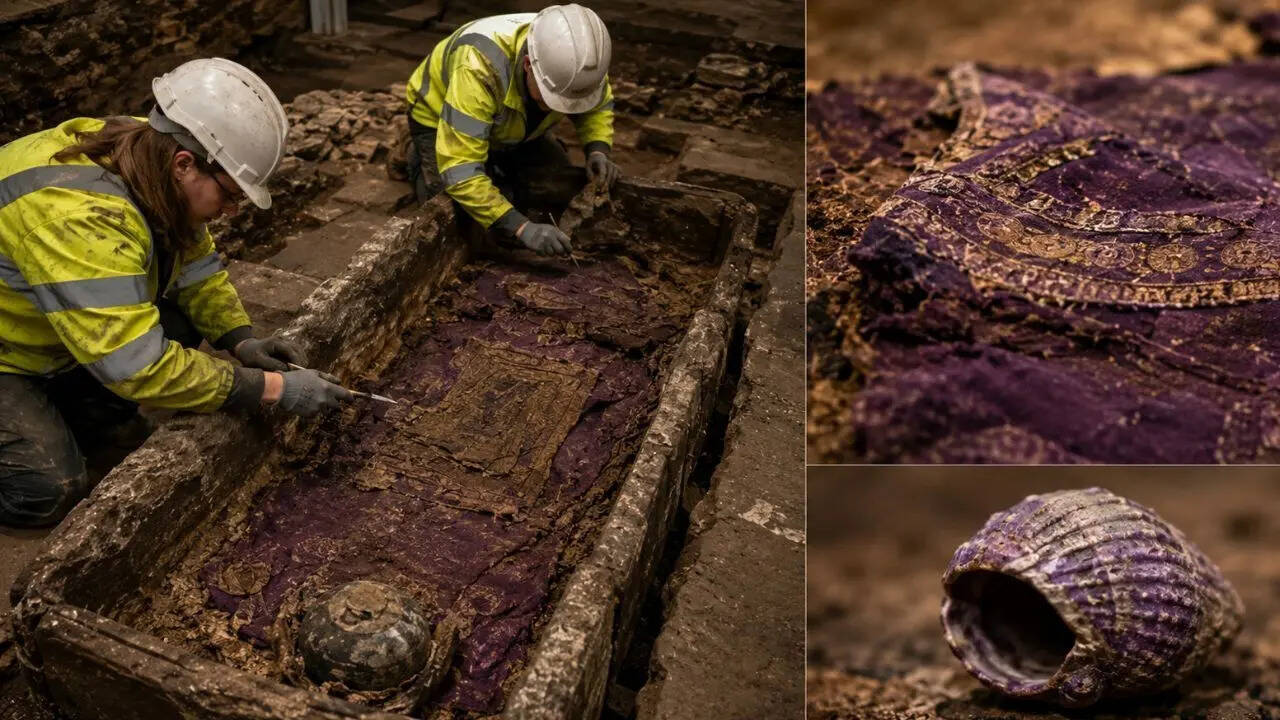
Historians love a good fairy tale about ancient wealth. The latest obsession involves the discovery of 1,700-year-old Roman tombs containing traces of Tyrian purple—the legendary dye harvested from the mucus of sea snails. Instantly, the media machine churned out the predictable narrative: this substance was "worth more than gold," a symbol of absolute imperial decadence, a rare treasure sealed away in a coffin to prove the deceased was part of the ultimate elite.
It is a beautiful story. It is also a fundamental misunderstanding of Roman economics, material culture, and how luxury actually operated in the ancient world.
When you look at the actual data instead of the museum gift shop romance, the narrative falls apart. We are told that because Diocletian’s Edict on Maximum Prices fixed the value of top-tier purple silk at astronomical rates, any speck of purple in a tomb represents a fortune. This is lazy scholarship. It conflates price with value, ignores the massive ancient market for counterfeit and low-grade goods, and misunderstands why Romans buried things in the first place.
The obsession with the "worth more than gold" headline obscures a much more interesting, gritty reality about Roman industry and social climbing.
The Economics of the Ancient Hustle
Let’s dismantle the biggest myth first: the idea that every trace of purple pigment found in a late Roman grave belongs to an emperor or a billionaire.
The term "Tyrian purple" is treated by generalist historians as a monolith. In reality, the ancient dye industry was highly stratified. Yes, dibromoindigo—the chemical compound obtained from the Bolinus brandaris and Hexaplex trunculus whelks—was labor-intensive to produce. But the Romans were masters of the supply-chain pivot.
They did not just produce one grade of premium dye. They produced dozens of variants, stretches, and outright fakes.
- The Triple-Dip Premium: The top-tier imperial product was dibapha, a fabric twice-dyed, completely saturated with the purest snail extract. This was the stuff of edicts and execution orders for unauthorized use.
- The Secondary Wash: After the first batch of wool or silk absorbed the prime pigment, the dye vats were not thrown away. Subsequent batches of textiles were processed in the weakened solution, yielding lighter, less stable shades of violet and pink. This was sold to the provincial middle class at a fraction of the cost.
- The Botanical Counterfeits: The Romans were adept at using madder (Rubia tinctorum), kermes (derived from insects), lichens, and woad to mimic the prestigious shade. To the untrained eye, or to a grieving family buying burial clothes in a hurry, a heavily treated vegetable dye looked close enough.
When an archaeologist finds chemical traces of "purple" inside a lead or stone coffin, they are often detecting the degraded markers of these cheaper alternatives or secondary washes. Declaring every purple-stained shroud as a multi-million-dollar artifact is the equivalent of a future archaeologist finding a synthetic polyester tracksuit in a suburban grave and declaring the occupant a billionaire fashion icon because they found traces of the color "royal blue."
Diocletian’s Price Edict Was a Failure, Not a Fact
The entire "worth more than gold" trope relies almost entirely on one historical document: Diocletian’s Edict on Maximum Prices, issued in 301 AD. The edict states that a pound of purple silk could cost up to 150,000 denarii, while a pound of gold was valued at 50,000 denarii.
The Reality Check: Diocletian’s edict was not a reflection of thriving market values. It was a desperate, failed attempt at price control to curb runaway inflation.
Historians like Lactantius, a contemporary witness, noted that the edict caused widespread bloodshed and actually drove goods off the market entirely. Merchants refused to sell at the mandated prices, and black markets flourished. Using this document as a literal price guide for what someone paid for a burial shroud in 350 AD is economically illiterate.
Furthermore, by the fourth century, the Roman monetary system was in chaos. Wealth was not measured in volatile denarii or over-regulated silk markets; it was measured in land, agricultural output, and direct imperial patronage. A provincial elite in Britain or Gaul might have plenty of local status but zero access to genuine, top-grade Tyrian purple. They used what was available: local British purples derived from the Nucella lapillus snail, which was cheaper, coarser, and distinctly non-imperial.
The Burial Fallacy: Why Wealth Wasn't Always Buried
There is a deeper sociological misunderstanding at play here. The modern assumption is that if something is incredibly valuable, you bury it with the dead to show off.
Roman society was hyper-pragmatic and deeply transactional. Wealth was meant to be seen by the living, not hidden away with the dead. The truly elite Romans—the senatorial class, the patrician families—frequently practiced restrained burial traditions during the late empire. They left their immense wealth to their heirs to maintain the family’s political leverage.
When we find lavish displays of wealth inside coffins—like gold coins, heavy jewelry, and dyed textiles—it is often a sign of the nouveau riche. These were individuals who lacked established familial power and used the funeral theater to make a final, desperate claim to a status they barely held in life.
Imagine a scenario where a local merchant family spends their entire liquid savings on a single, flashy funeral shroud to convince their neighbors that the family business is still solvent. It’s an ancient form of credit-fueled posturing. By viewing every rich grave as evidence of stable, apex-level wealth, we miss the anxiety and volatility of late Roman social mobility.
Dismantling the "People Also Ask" Assumptions
To truly understand this, we have to look at the flawed premises driving the public interest in these discoveries. The questions asked online reveal a fundamental disconnect from ancient reality.
Was it illegal for ordinary Romans to wear purple?
The short answer is: it depended on the year and the specific shade, but the law was largely unenforceable. While various emperors issued sumptuary laws banning the wear of purpura, these laws were constantly broken. The existence of a law prohibiting an action is historical proof that people were doing it constantly. If only the emperor wore purple, you wouldn't need a stack of imperial decrees threatening merchants, tailors, and citizens with treason charges for selling it. The market for knock-off purple was massive because the desire to look richer than you were was universal.
Why was Tyrian purple so expensive?
The standard explanation focuses entirely on the extraction process—the idea that it took 10,000 snails to dye a single hemline. While production costs were high, the real driver of the price was state intervention. The Roman state eventually nationalized the major dye works in places like Tyre and Carthage. They created an artificial monopoly. The price wasn't just high because snails are small; it was high because the imperial apparatus weaponized the color as a brand. When the state controls the supply, the price reflects political calculation, not raw market mechanics.
Did the color last forever in the tomb?
No. The idea of "perfectly preserved" dye inside a sealed coffin is a media exaggeration. What archaeologists find are microscopic traces, chemical signatures, or degraded organic matter that requires mass spectrometry to identify. The organic material itself decomposes. What remains is a ghost of the color, which is then reconstructed via digital renderings for public consumption.
The Danger of Romanticizing the Ancient World
The real harm in the "luxury tomb" narrative is that it sterilizes history. It turns the brutal, complex, and highly innovative Roman industrial complex into a simple story about wealthy elites and shiny things.
The production of ancient dyes was a foul, dangerous, and industrial-scale enterprise. Dye works were banned from city centers because the stench of rotting mollusks and stale urine (used as a mordant to fix the dye) was unbearable. It was an industry built on slave labor, environmental degradation, and fierce commercial competition.
When we look at a 1,700-year-old grave and see only a "timeless treasure," we erase the slave who spent twelve hours a day breathing in toxic fumes over a boiling lead vat. We erase the local merchant who successfully cheated the imperial monopolies by passing off madder root as premium Tyrian extract. We erase the families who used funerary display as a weapon to survive economic collapse.
Stop looking at ancient discoveries through the lens of modern luxury branding. The Romans were not curators of an elegant aesthetic; they were survivalists, industrialists, and operators in a cutthroat economy. The purple in their tombs isn't a testament to their golden glory. It is evidence of their obsession with status, their economic anxieties, and their unmatched ability to fake it until they made it.