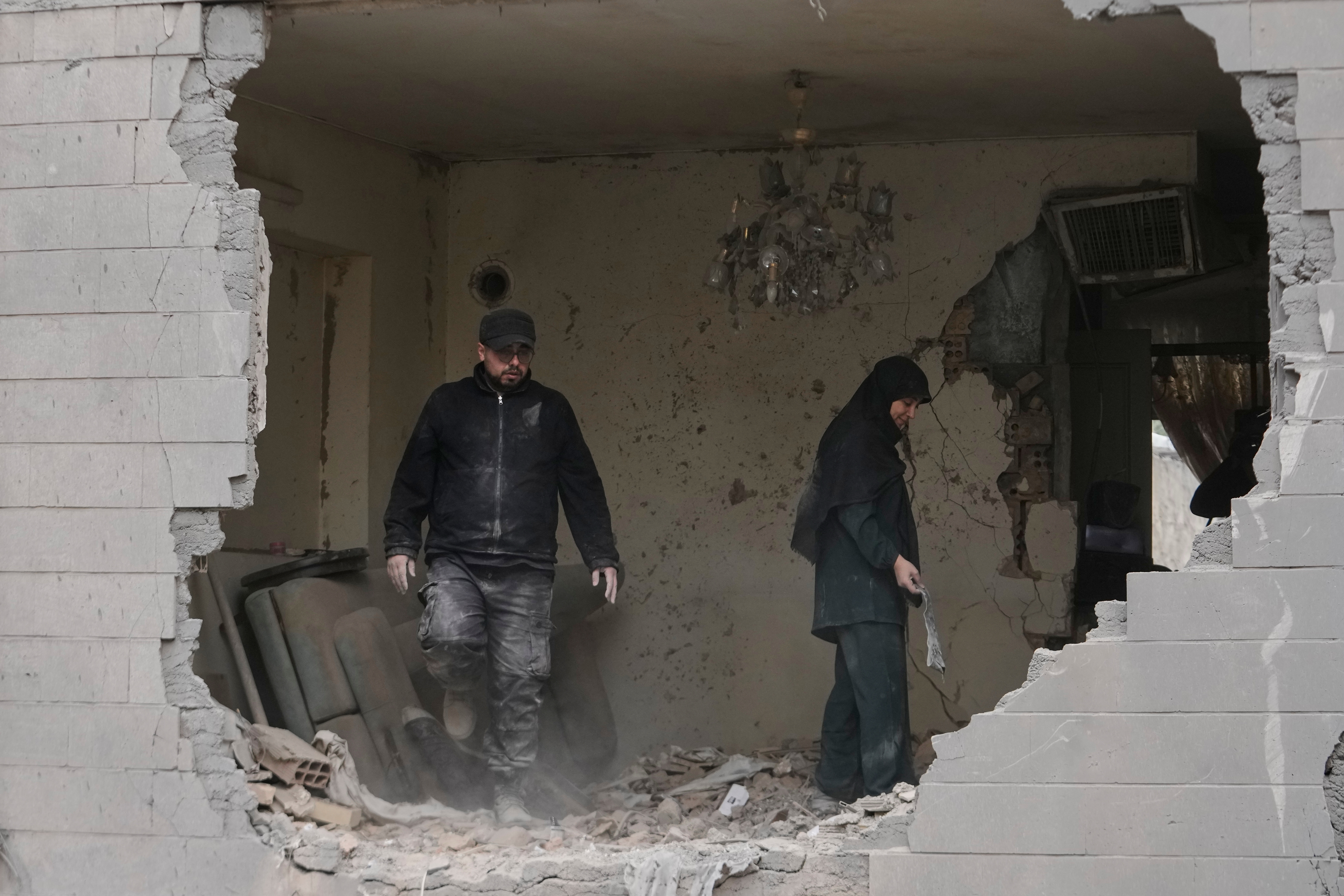
The current conflict has entered a phase of calculated asymmetric attrition where Iran's military doctrine shifted from proxy preservation to direct infrastructure degradation. While the first two weeks of the war focused on localized skirmishes and information operations, the transition into the third week marks a departure toward targeting high-value economic nodes—specifically oil facilities across the Gulf. This isn't a desperate lunge; it is the execution of a "cost-imposition strategy" designed to leverage the vulnerability of global energy supply chains against the superior conventional military weight of its adversaries.
The Triple-Threat Architecture of Iranian Force Projection
Iran’s current operational model rests on three distinct but reinforcing pillars of escalation. Understanding these pillars allows for a move beyond the vague "defiance" reported in mainstream media into a structural analysis of how Tehran exerts pressure.
- Proximate Denial (The Bottleneck Effect): Utilizing the geography of the Strait of Hormuz to create a risk premium on every barrel of oil. By targeting facilities near the coast, Iran forces a recalculation of insurance premiums and shipping routes without needing to fully close the waterway.
- Dispersed Precision (The Drone-Missile Mix): The use of low-cost, high-precision loitering munitions and cruise missiles allows for "surgical economic trauma." By hitting specific de-sulfurization units or storage tank manifolds rather than entire refineries, they maximize repair time and technical complexity while minimizing the immediate environmental outcry that might trigger a global kinetic response.
- Political Insulation through Deniability: Even when the source is technically identifiable, the use of diverse launch points—ranging from Iranian soil to mobile platforms in Yemen or Iraq—creates a "dilution of accountability." This forces the international community into a legalistic quagmire, delaying a unified retaliatory strike.
The Cost Function of Energy Infrastructure Attacks
To quantify the impact of these strikes, one must look at the Mean Time To Recovery (MTTR) of specialized oil infrastructure. Standard refinery components are not off-the-shelf items; they often require bespoke engineering and lead times that span months.
When a drone strikes a stabilizer column or a specialized pump house, the economic damage isn't measured merely in the lost oil from that day. It is measured in the Operational Downtime Multiplier. If a facility produces 500,000 barrels per day (bpd) and a specific strike takes a critical unit offline for 90 days, the total loss is 45 million barrels. At a hypothetical $90 per barrel, a single successful $20,000 drone flight achieves a direct economic impact of $4.05 billion, excluding the secondary effects on global spot prices and domestic inflation in consumer nations.
This creates an unfavorable exchange ratio for defensive forces. A Patriot interceptor missile can cost between $2 million and $4 million. If an adversary launches a swarm of 20 "Shahed-style" drones costing $30,000 each, the defender spends $40 million to $80 million to stop $600,000 worth of equipment. This is the Asymmetric Deficit: the defender must be perfect 100% of the time, while the attacker only needs a single breach to achieve their strategic objective.
Strategic Resilience and the Limits of Hardening
The common "People Also Ask" query regarding why these facilities aren't better protected ignores the physics of industrial scale. You cannot "armor" a 500-acre refinery. The vulnerability is systemic, not incidental.
- Sensor Saturation: Modern air defense systems are optimized for high-altitude, high-speed threats. Low-altitude, slow-moving drones with small Radar Cross Sections (RCS) disappear into "ground clutter."
- Interconnectedness as a Liability: Modern Gulf oil infrastructure is highly integrated. A strike on a power substation in one sector can cause a pressure surge in a pipeline miles away, leading to secondary failures.
- The Human Capital Bottleneck: Physical repairs require specialized technicians. In a wartime environment, moving international engineering teams into a "hot" zone becomes a logistical and insurance nightmare, further extending the MTTR.
The Feedback Loop of Regional Escalation
Iran’s defiance is rooted in the belief that the "Pain Threshold" of the global West is lower than its own. This is a classic application of Game Theory, specifically the "War of Attrition" model. In this model, the winner is the player who can endure the highest cost for the longest time.
By hitting oil facilities, Iran shifts the cost of the war from the local battlefield to the global gas station. This creates a feedback loop:
- Strikes occur on Gulf facilities.
- Global oil prices spike due to perceived supply risk.
- Political pressure builds in Washington, London, and Brussels to "de-escalate."
- De-escalation usually involves offering concessions to Iran or its proxies.
Therefore, the strikes are not an end in themselves; they are the "transmission mechanism" for political leverage.
Structural Vulnerabilities in Global Intelligence
The current intelligence failure is not a lack of data, but a failure of Anticipatory Pattern Recognition. Analysts often wait for "clear signals" of an impending strike, such as troop movements or radio silence. However, the Iranian model utilizes "latent readiness." The drones and missiles are already in place, often pre-programmed with GPS coordinates for months. The "order to fire" can be sent via encrypted, low-bandwidth channels that are nearly impossible to distinguish from routine traffic.
This creates a Response Lag. By the time a strike is confirmed and the origin is debated, the economic damage is already "baked into" the market. The window for a meaningful deterrent strike closes as the international community pivots to crisis management and market stabilization.
The Mechanics of Deterrence Failure
Deterrence fails when the "Expected Utility" of an attack outweighs the "Expected Cost" of retaliation. For Tehran, the internal political cohesion gained from appearing "defiant" against Western-aligned interests provides a significant domestic utility. Simultaneously, they have calculated that the West is currently "escalation-averse" due to:
- Thinning munitions stockpiles due to other global conflicts.
- Fragile domestic economies sensitive to energy price shocks.
- A lack of consensus on what a "post-escalation" Middle East looks like.
As long as these variables remain constant, the kinetic friction against oil facilities will likely intensify rather than dissipate.
The move from "localized war" to "regional infrastructure war" necessitates a fundamental shift in defensive strategy. Passive defense (interception) must be supplemented by "Active Resilience"—the pre-positioning of modular repair components and the hardening of cyber-physical interfaces that control pipeline flow. Without a structural change in how infrastructure is defended and how costs are returned to the aggressor, the Gulf remains a high-beta environment where a $30,000 drone can dictate the rhythm of the global economy.
The most effective strategic play involves a "Decoupled Response Model." Instead of responding to energy infrastructure strikes with symmetrical military force—which risks further price spikes—the focus must shift to aggressive, targeted financial and technical interdiction of the supply chains that produce the drone components. Severing the "Silicon Arteries" that feed the Iranian aerospace industry provides a path to degrading their capability without providing the immediate "martyrdom" narrative or the kinetic escalatory ladder they currently seek to climb.