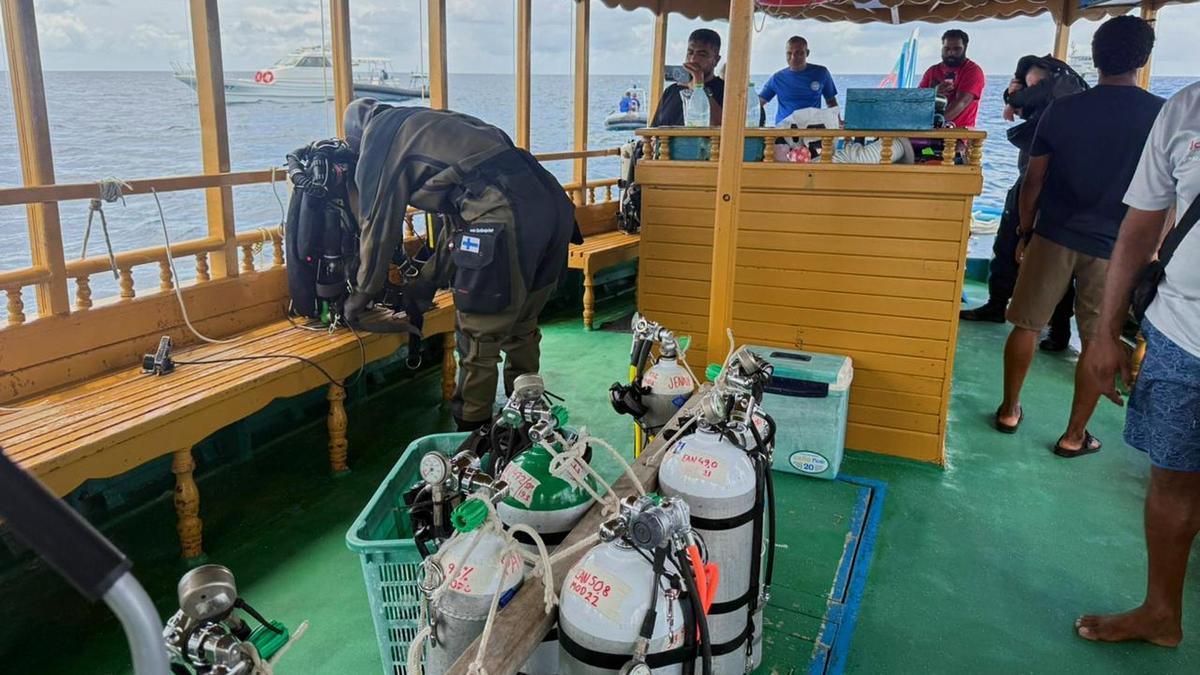
The recovery of deceased divers from submerged cave systems represents the absolute ceiling of operational risk in technical diving. When two Italian divers perished in an underwater cave system in the Maldives, the subsequent deployment of specialized Finnish recovery divers highlighted a stark reality: deep-water cave extraction is not a standard search-and-rescue operation, but a highly complex, resource-intensive engineering and logistical challenge. Ordinary commercial or military diving protocols fail in these environments. Success requires an analytical breakdown of environmental constraints, physiological limits, and team structures to understand how these high-stakes operations are executed when mitigation turns entirely into body recovery.
The Environmental Matrix: The Constraints of Cave Systems
Underwater caves introduce a compounding series of physical variables that create an unforgiving operational envelope. Unlike open-water diving, where vertical ascent is always an option in an emergency, cave diving operates under a physical overhead obstruction. This changes the safety calculus from a simple time-depth equation to a linear distance-penetration problem. Meanwhile, you can read other events here: The Ground That Forgot How to Hold Still.
Three primary environmental vectors dictate the difficulty of a recovery mission:
- Visibility Degradation (The Silt Factor): Cave walls and floors are frequently covered in fine particulate matter or silt. A single displaced swim fin stroke can instantly reduce visibility from thirty meters to zero. This creates a permanent risk of spatial disorientation, even when a physical guide line is present.
- Geometric Confinement: Passageways often narrow into "restrictions" where a diver cannot pass without removing their equipment or shifting their profile. This creates physical bottlenecks that impede the transport of recovery payloads (the deceased).
- Current and Flow Dynamics: Many cave systems feature high flow rates (siphons or springs). Navigating against a current accelerates gas consumption, while navigating with a current increases the risk of being swept deeper into unmapped sections of the system.
In the Maldives incident, the intersection of these variables required a specialized skill set possessed by only a handful of global teams. The choice of Finnish divers—frequently trained in the cold, zero-visibility, enclosed mines of Northern Europe—reflects a deliberate matching of environmental familiarity to the specific rigors of the site. To see the bigger picture, we recommend the detailed article by The New York Times.
The Physiological and Gas Management Cost Function
To operate safely at depth within an overhead environment, recovery teams must calculate gas management using strict mathematical margins. The foundational framework is the Rule of Thirds, which dictates that one-third of the total gas supply is allocated for penetration, one-third for the exit, and one-third is reserved as an emergency reserve for a diving partner.
However, in deep recovery operations, the Rule of Thirds is often modified to the Rule of Fourths or Fifths due to the elevated metabolic rate associated with manual labor at depth.
$$\text{Gas Allocated for Penetration} = \frac{\text{Total Gas Volume}}{\text{Safety Margin Factor}}$$
When working at significant depth, divers must manage two primary physiological threats: Nitrogen Narcosis and Gas Density.
The Narcotic Depth Limit
Breathing standard air at depth introduces severe cognitive impairment due to the narcotic effects of nitrogen under pressure. At depths exceeding 30 meters, mental processing slows, and problem-solving capabilities degrade. Recovery operations utilize Trimix—a breathing gas mixture of helium, nitrogen, and oxygen. Helium replaces a portion of the nitrogen and oxygen to reduce gas density and eliminate the narcotic effect, maintaining cognitive clarity for complex rigging and navigation tasks.
The Gas Density Bottleneck
As depth increases, ambient pressure increases, making the breathing gas denser. At a certain threshold, the physical effort required to breathe dense gas through a regulator creates a buildup of carbon dioxide ($CO_2$) in the bloodstream (hypercapnia). Hypercapnia induces panic, accelerates gas consumption, and can cause sudden unconsciousness. Managing gas density requires highly sophisticated closed-circuit rebreathers (CCRs) that recycle exhaled gas, scrub $CO_2$, and optimize the oxygen fraction in real-time.
The Operational Protocol of Technical Extraction
A recovery operation is divided into four distinct phases, each requiring meticulous execution to prevent the recovery team from becoming casualties themselves.
[Phase 1: Scouting & Line Installation]
               │
               ▼
[Phase 2: Body Stabilization & Rigging]
               │
               ▼
[Phase 3: Transport & Restriction Navigation]
               │
               ▼
[Phase 4: Staged Decompression & Surface Handover]
Phase 1: Scouting and Line Installation
The initial team penetrates the system to locate the victims, assess the stability of the environment, and lay a continuous, high-tensile guide line from the open water directly to the site. This line serves as the sole navigation vector for all subsequent teams.
Phase 2: Body Stabilization and Rigging
Recovering a human body from an underwater cave requires altering its buoyancy and profile. The deceased diver's equipment may be partially stripped or secured to prevent snagging. The body is typically placed within a specialized, hydrodynamic recovery bag fitted with independent buoyancy control to allow the recovery diver to neutralize the weight during transport.
Phase 3: Transport and Restriction Navigation
Moving a payload through narrow restrictions requires a two-diver team configuration. The lead diver guides the payload through the restriction from the front, while the support diver manages the lines and monitors for silt blowouts from behind. If visibility drops to zero during this phase, progress halts, and the team relies entirely on tactile communication and the pre-installed guide line.
Phase 4: Staged Decompression
Because the recovery team operates under extreme pressure for extended periods, they cannot ascend directly to the surface. Doing so would cause dissolved gases in their tissues to form bubbles, resulting in decompression sickness (the bends). The team must stop at calculated depth intervals for minutes or hours to allow the gas to safely eliminate from their bodies. The payload must either be staged at these decompression stops or handed off to shallower support teams to ensure the recovery divers do not compromise their own decompression profiles.
Institutional Knowledge and Global Dispatch Frameworks
The reliance on Finnish divers for an operation in the Maldives underscores the highly centralized nature of extreme technical diving expertise. Organizations like the International Underwater Cave Rescue and Recovery (IUCRR) and localized specialized groups maintain registers of divers qualified for these specific scenarios.
The decision framework for deploying an international asset involves three primary assessments:
- Legal and Sovereign Jurisdiction: Local authorities must formally cede operational control of the dive site to the incoming technical team, as standard police and military diving units lack the equipment and training for deep cave penetration.
- Equipment Interoperability: The incoming team must either transport hundreds of kilograms of highly specialized life-support equipment (CCRs, custom gas blending panels, dpvs/underwater scooters) or ensure that local logistical chains can provide specific gas purity standards (such as medical-grade oxygen and high-purity helium).
- Risk-Benefit Threshold: If the physical condition of the cave system has deteriorated significantly since the accident (e.g., structural collapse or active flooding), the operational commander must determine if the probability of a successful recovery justifies the statistical risk to the recovery team.
Operational Limitations and Risk Boundaries
The primary limitation of any deep cave recovery is that the margin for error is absolute zero. In open water, a equipment malfunction can often be solved by a rapid ascent. In a cave system, an equipment failure miles from the entrance requires immediate, autonomous problem-solving under extreme stress.
The introduction of a human body into the transportation dynamic increases the physical profile of the diver-payload unit, doubling the surface area prone to snagging on cave projections. Furthermore, the psychological weight of handling deceased peers in dark, confined spaces accelerates heart rates and breathing rates, shortening the operational window afforded by the gas supply.
Tactical Resource Deployment Matrix
The success of these missions relies on a highly structured team hierarchy rather than individual heroism. The operational footprint is balanced across three tiers:
- The Primary Penetration Team: Two to three highly experienced cave divers who interact directly with the recovery site. They possess the highest technical certifications and are responsible for the physical extraction.
- The Support and Gas Staging Team: Divers positioned at the mouth of the cave or at intermediate depths. They place emergency gas cylinders along the exit route and assist the primary team during the lengthy decompression phases.
- The Surface Command Element: Manages the logistics, monitors dive times against planned profiles, coordinates emergency hyperbaric medical care on standby, and handles the chain of custody for the recovered individuals.
This tiered system ensures that if a primary diver experiences a rebreather failure or physical entrapment, a pre-briefed support team is already in the water, fully aware of the timeline and position, ready to execute a rescue protocol. The Maldives recovery succeeded not due to favorable conditions, but because the discipline of the deployed Finnish team matched the exact structural demands of the environment.