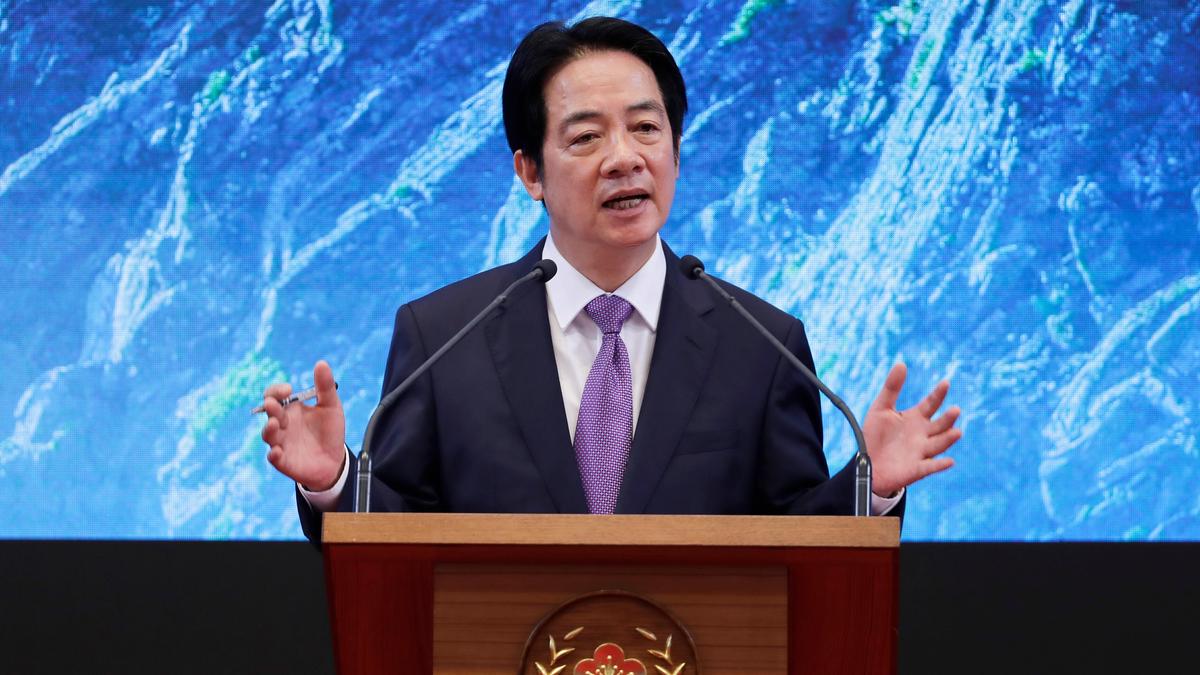
Taiwanese President Lai Ching-te's public declaration that he intends to communicate the critical necessity of continued U.S. arms purchases directly to U.S. President Donald Trump exposes a fundamental friction point in modern geopolitics: the collision between institutionalized defense treaties and transactional diplomacy. Taiwan treats defense acquisition as an existential deterrence function; the current U.S. executive administration views it as an economic variable and a geopolitical negotiating mechanism.
To analyze how this friction alters the stability of the Taiwan Strait, one must look past political rhetoric and break the relationship down into its component structural drivers: legislative frameworks, transactional negotiation models, and hardware delivery logistics.
The Structural Mechanics of Bilateral Defense Procurement
The security architecture between Washington and Taipei does not operate on executive whim. It is governed by a rigid legal and economic framework established over decades. The baseline mechanism is the Taiwan Relations Act (TRA) of 1979, which legally mandates that the United States provide Taiwan with defense articles and services in such quantity as may be necessary to enable Taiwan to maintain a sufficient self-defense capability.
The process involves a multi-stage approval and financing pipeline that converts Taiwanese capital into American hardware. The economic inputs of this function have accelerated drastically:
- The December Baseline: An $11 billion arms package approved by the Trump administration, encompassing precision missiles, unmanned aerial vehicles (drones), advanced artillery systems, and critical military software.
- The Pending Pipeline: A $14 billion capital allocation for secondary procurement that has cleared initial legislative hurdles but requires formal executive submission to the U.S. Congress to activate manufacturing schedules.
For Taiwan, the financial execution of these contracts serves as a sovereign validation metric. By dedicating a rapidly increasing percentage of its gross domestic product (GDP) to the defense budget, Taipei seeks to satisfy the U.S. demand for burden-sharing while systematically raising the cost function of any potential military annexation by the People's Republic of China (PRC).
The Cost Function of Transactional Diplomacy
The friction in this state of affairs stems from a conceptual misalignment in how both administrations define a "negotiating chip." During his high-stakes summit in Beijing, President Trump explicitly categorized the pending $14 billion hardware package as an asset dependent on Chinese concessions, stating it was "a very good negotiating chip."
This introduces a game-theoretic vulnerability into cross-strait deterrence. When defensive hardware packages are repositioned as trade or diplomatic leverage, the underlying deterrence model shifts from a rule-based certainty to a variable transaction.
The Bilateral Friction Matrix
The conflicting priorities between the two administrations can be mapped across three distinct vectors:
| Vector | Taipei Strategic Position | Washington Transactional Position |
|---|---|---|
| Primary Objective | Sovereign survival via unassailable cross-strait deterrence. | Global trade concessions and asymmetric leverage over Beijing. |
| Hardware Valuation | Existential security infrastructure with fixed requirements. | Liquid economic assets and manufacturing job creators. |
| Third-Party Influence | Complete exclusion of Beijing's input on bilateral defense. | Conditional approval tied to Chinese diplomatic compliance. |
This divergence creates an immediate structural bottleneck. While legislative blocks in the U.S. Congress, backed by figures like House Speaker Mike Johnson, reinforce the traditional interpretation of the TRA, the executive branch retains significant administrative power over the velocity of these sales. This executive friction can slow down the formal transfer of technology without explicitly violating statutory obligations.
The Operational Reality of the Defense Industrial Base
Political rhetoric frequently ignores the material constraints of industrial manufacturing. Even when an arms package achieves full executive approval, the actual delivery timeline remains tethered to a highly constrained global defense supply chain.
The global defense industrial base is suffering from unprecedented capacity limitations. The production lines for advanced anti-ship missiles, precision-guided munitions, and air defense tracking software face long lead times. These delays are exacerbated by competition for components, specialized raw materials, and semiconductor availability.
Consequently, a pause or a delay in submitting a contract to Congress does not simply move a delivery date on a calendar; it resets Taiwan's position in the global manufacturing queue. If the pending $14 billion package sits in administrative limbo while being utilized as a diplomatic counterweight, the actual operational readiness of the Republic of China Armed Forces suffers a multi-year compounding delay. This structural lag directly erodes the credibility of Taiwan’s defense posture, regardless of the financial commitments made by Taipei.
Mitigating Sovereign Agency Risk
The primary risk for Taiwan within a transactional diplomatic framework is the systematic loss of strategic agency. If the island's defense capability is perceived as an asset to be traded away or paused to secure broader Western concessions on tariffs or intellectual property, the deterrence value of the U.S.-Taiwan relationship depreciates.
To counter this vulnerability, Taiwanese statecraft must shift from a posture of passive procurement to one of deep, indispensable integration within the democratic technological ecosystem. This requires execution across two operational tracks:
Accelerated Co-Production Agreements
Taipei must pivot from purely purchasing completed American systems to securing domestic co-production rights for critical defense sub-components. By integrating Taiwanese manufacturing centers directly into the supply chains of U.S. defense contractors, the interruption of an arms package would damage American domestic production schedules just as much as it would affect Taiwanese security. This creates a shared economic vulnerability that insulates defense agreements from sudden policy shifts.
Indispensable Technological Hegemony
The state must maintain its absolute dominance in advanced logic semiconductor manufacturing through entities like TSMC. By anchoring global technology infrastructure within its borders, Taiwan ensures that the economic cost of cross-strait conflict remains unsustainably high for all global actors, including the United States and China. The "Silicon Shield" must be systematically upgraded to outpace any attempts to diversify critical chip fabrication to alternative geographies.
Ultimately, the preservation of peace across the Taiwan Strait will not be achieved through rhetorical appeals to shared democratic values. It requires the precise, unyielding alignment of capital, legal statutes, and industrial capacity. Taipei’s optimal strategic path is to make its defense pipeline so economically integrated with American industrial interests that pausing a weapons sale becomes a net-negative transaction for Washington, regardless of any concessions Beijing offers.