The air in the Sambisa Forest does not move. It hangs thick with the scent of charred acacia wood, damp earth, and the metallic tang of old fear. For a decade, this swath of northeastern Nigeria has been a black hole on the map, a place where geography swallows armies. Under the canopy, miles from any paved road, a man checks the glowing screen of a satellite phone. He believes the canopy protects him. He believes the vast, empty miles of the Borno State border are his impenetrable fortress.
He is wrong.
Seven thousand miles away, in a windowless room bathed in the blue glow of monitors, a cursor hovers over a grid coordinate. There is no sound here except the low hum of cooling fans and the rhythmic clicking of a mechanical keyboard. The distance between the hunter and the hunted has been erased by fiber-optic cables and orbiting silicon.
When news broke that a joint operation between United States special operations forces and the Nigerian military had eliminated a top-tier Islamic State leader in West Africa, the press releases were predictably sterile. They spoke of "synergy," "neutralization," and "strategic cooperation."
But geography and geopolitics are never sterile. They are written in sweat, adrenaline, and the sudden, violent shattering of the desert silence.
The Ghosts in the Machine
To understand how a militant leader dies in the remote bush of West Africa, you have to understand the invisible web that connects a mud-walled compound in Africa to an airbase in Nevada or a command center in Stuttgart.
For years, the war against insurgency in the Sahel was a meat-grinder. Ground troops moved through thorn scrub and soft sand, vulnerable to ambushes, landmines, and the unforgiving sun. The insurgents knew the terrain. They knew every dry riverbed, every cave, every village where fear or loyalty could buy silence. They operated in the blind spots of global intelligence.
Then the sky began to watch.
Consider the mechanics of a modern targeted strike. It does not begin with a missile. It begins months earlier with a single whisper of data. A intercepted radio transmission. A sudden spike in encrypted data traffic from a tower that usually only handles local livestock traders. A pattern of life established by long-endurance drones flying so high they are invisible to the naked eye.
The trackers look for anomalies. Why does a specific courier travel forty miles by motorbike every Tuesday to a dead-end track? Why does a generator run for six hours every night in a village with no electricity?
The data accumulates. It pours into servers, where algorithms sort the signal from the noise. But algorithms do not make the final call. Humans do. Intelligence analysts pore over grainy thermal imagery, tracing the outline of a shoulder, the specific gait of a target walking with a slight limp from an old shrapnel wound.
The Alliance of Necessity
The official announcement from Washington carried the unmistakable cadence of a political victory lap. A president standing at a podium, declaring another enemy of the free world removed from the battlefield. It is a familiar ritual.
But behind the political theater lies a messy, complicated reality. The United States cannot operate in this region alone. Sovereignty matters, even in the middle of a conflict zone.
Nigeria possesses the raw manpower, the deep regional knowledge, and the ultimate stake in the outcome. Their soldiers are fighting for their own villages, their own families. But the Nigerian military has long been hampered by a lack of high-altitude surveillance capability and precision-guided technology.
The partnership is a trade. Washington provides the eyes in the sky and the scalpel-like precision of its technical intelligence. Abuja provides the boots on the ground, the cultural context, and the hard-won human intelligence that no satellite can ever replicate.
Imagine the moments leading up to the breach.
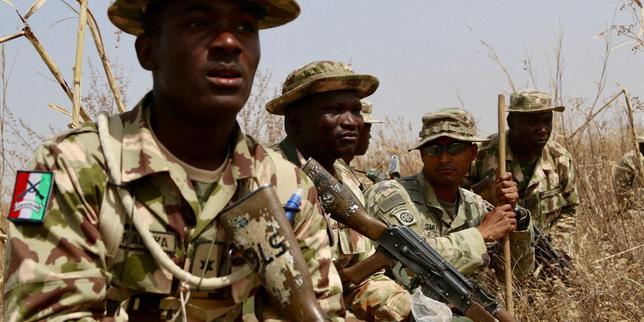
Nigerian tactical units, trained in deep-woods reconnaissance, move into position under the cover of a moonless night. They are wearing heavy body armor in the suffocating heat. Every step must be silent. A snapped twig can ruin months of planning. Above them, loitering in the blackness, an American drone tracks the perimeter, feeding real-time thermal video to the assault team’s command element.
The target is asleep, or perhaps praying. He believes he is a ghost.
Then the world explodes.
The firefight is brief but intense. The muzzle flashes light up the trees like strobe lights in a nightclub. Dust rises, choking the air. When the smoke clears, the hierarchy of a global terror franchise has been disrupted once again.
The Illusion of the Vacuum
It is easy to look at these operations as a series of disconnected events. A name is crossed off a list. A press conference is held. The public moves on to the next news cycle.
But killing a leader does not kill an ideology.
The history of the conflict in West Africa is a history of hydras. You cut off one head, and two more emerge from the swamp. When Boko Haram fractured years ago, giving birth to the Islamic State West Africa Province (ISWAP), many thought the internal rift would destroy the movement. Instead, it created a leaner, more technologically savvy, and more lethal entity.
The real stakes are not found in the body counts. They are found in the aftermath.
When a commander dies, he leaves behind a treasure trove of intelligence. Cell phones, hard drives, handwritten notebooks, pocket diaries. This is the real prize of a joint operation. While the public focuses on the elimination of a threat, intelligence agencies are already feeding the captured data into the system, looking for the next link in the chain.
The digital footprints left behind in a hasty retreat tell the story of where the money comes from, who is supplying the weapons, and which Western tech platforms are being exploited to spread propaganda. The modern insurgent uses the same encryption tools as a Silicon Valley executive. They use cryptocurrency to bypass traditional banking systems. They recruit through video game chat rooms.
The battlefield is no longer just the dirt of the Sambisa Forest. It is the global digital infrastructure.
The Human Cost of Precision
We are told that modern warfare is precise. We see the crosshairs on the screen, the sudden puff of smoke, the clean resolution of a tactical problem.
The reality on the ground is never clean.
Every operation carries the weight of collateral risk. In the villages surrounding the target zones, civilians live in a state of permanent hyper-vigilance. They hear the distant, low drone in the sky—a sound that has become a permanent feature of the Sahelian atmosphere. They know that a mistake in intelligence, a misidentified vehicle, or a malfunctioning guidance system can mean the destruction of a household.
The trust required to make these joint operations successful is fragile. It requires the American operators to trust the integrity of Nigerian intelligence, ensuring they are not being used to settle local political scores. It requires the Nigerian commanders to trust that their sovereignty is being respected, that they are partners rather than just proxies in someone else’s global war.
When the operation succeeds, the political leaders shake hands. The communiqués are drafted. The success is weaponized for domestic political consumption in Washington, a demonstration of strength and resolve. In Abuja, it is framed as a turning point in a long national trauma.
But for the soldiers who crawled through the thorn bushes, the victory is measured simply by the fact that they got back into the transport trucks alive.
The sun rises over Borno State, hot and blinding. The dust settles back onto the leaves of the acacia trees. The compound is quiet now, a ruined shell of mud and timber. Somewhere else, in another hidden camp across the border in Niger or Chad, a young man receives a message on a secure app. He has just been promoted. He knows exactly what happened to his predecessor. He hooks his phone to a solar charger, sits down in the shade, and begins to type.