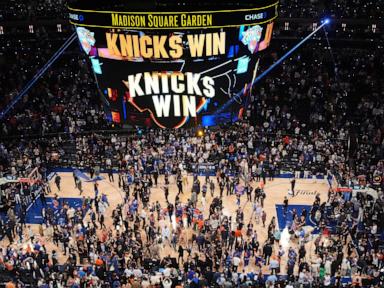
The concrete beneath Pennsylvania Plaza vibrates long before you actually hear the noise. It is a low, rhythmic hum, the collective anxiety of nineteen thousand people trapped inside a concrete drum, waiting for a execution that feels entirely scheduled.
By halftime, the mood inside Madison Square Garden was not anger. Anger requires energy. This was a heavy, suffocating apathy. The scoreboard read like a autopsy report. The San Antonio Spurs, a team built with the cold, mathematical precision of an algorithm, were up by twenty-eight points.
Basketball, at its highest level, is supposed to be a game of runs. But a twenty-eight-point deficit against a disciplined team isn't a run. It is a burial. In the nosebleeds, fans were already calculating the train schedules back to Long Island. The concession stands were quiet. The beer was warm.
To understand what happened next, you have to understand the specific cruelty of being a New York sports fan. We do not expect perfection. We expect effort. When the home team walks through the first two quarters like ghosts in custom sneakers, the silence of the Garden is louder than any booing. It is the sound of a city withdrawing its love.
But sports are not played on a spreadsheet. They are played by flawed, tired human beings who occasionally get tired of being embarrassed.
The Chemistry of Total Collapse
When a team is down by nearly thirty points, the tactical playbook becomes completely useless. You cannot execute a standard half-court offense to chip away at a mountain. The math is against you. The clock is a countdown to public humiliation.
Consider what happens inside a huddle during a timeout like that. The coach isn't drawing up plays anymore. He is looking for a pulse.
The turnaround began not with a spectacular three-pointer or a shattering dunk, but with a foul. A hard, unnecessary, borderline reckless foul in the paint. It was the basketball equivalent of a desperate man throwing a punch in a dark alley just to prove he can still lift his arms. It sent a message to the floor, and more importantly, to the rafters: We are still here.
Suddenly, the spacing changed. The Knicks stopped playing to win the game and started playing to win the next thirty seconds.
The Spurs, comfortable in their cushion, eased off the gas just a fraction of an inch. In professional sports, a fraction of an inch is a mile. A pass that was crisp in the first quarter arrived half a second late in the third. A dribble that was tight became loose. The Knicks began to jump into those passing lanes, turning defense into a chaotic, scrambling sprint.
The Geography of Sound
There is a distinct moment in a historic comeback where the air pressure in the arena changes. It usually happens around the twelve-point mark.
Twelve points is the threshold of belief. At twenty points, you are playing for pride. At twelve points, the opposing bench stops laughing. The coach of the leading team stands up, suddenly aware that his comfortable evening has turned into a dogfight.
The Garden did not erupt all at once. It built like a storm front moving over the Hudson. A steal. A transition layup. A missed free throw by the Spurs. A three-pointer from the corner that rattled around the rim before dropping through the net.
With every possession, the noise grew more hostile. It became a physical presence on the floor, a wall of sound that seemed to push the Knicks forward and push the Spurs back. The young San Antonio players, accustomed to the polite, clinical execution of their system, looked around the arena as if they had suddenly been dropped into a Roman colosseum.
The human mind is fragile under that kind of pressure. When you know you are supposed to win, the fear of losing becomes paralyzing. The basket shrinks. The ball feels like a stone. The Spurs began to turn the ball over not because of brilliant defensive schemes, but because the floor beneath them felt like it was shaking.
The Final Three Minutes
The lead was gone with two minutes left on the clock. The game was no longer about basketball; it was about survival.
Every possession felt like a heavy-duty collision. Players were sliding across the hardwood, diving for loose balls as if their lives depended on it. The statistics from the first half—the shooting percentages, the rebound differentials—were completely irrelevant. The only thing that mattered was momentum, that invisible, terrifying force that dictates the outcome of human endeavors.
The Knicks took the lead on a broken play. A missed jumper, an offensive rebound grabbed out of mid-air by sheer force of will, and a put-back that seemed to hang on the rim for an eternity before falling.
The final buzzer did not just signify the end of a basketball game. It felt like a release valve blowing on a pressure cooker.
The scoreboard confirmed the impossible: the largest comeback victory in the franchise's modern history. The people who had been looking at train schedules at halftime were now hugging strangers in the aisles.
We walked out into the cold New York night, our throats raw, our hands bruised from clapping. Nothing had actually changed in the grand scheme of things. The taxes were still high. The subways were still late. The city was still brutal and unforgiving. But for a few hours on a Tuesday night, we had witnessed a group of men refuse to accept the narrative that had been written for them. We had watched them fight their way out of a grave, and in doing so, they reminded everyone in the building why we keep showing up, night after night, hoping for a miracle.