Kim Jong Un’s recent escalation of missile testing during the Israel-Iran conflict is not a coincidental display of strength but a calculated exercise in Geopolitical Opportunism. By synchronizing missile provocations with the saturation of Western air defense resources in the Middle East, Pyongyang is testing the elastic limits of the United States’ "Two-Theater" capability. The strategic intent is to devalue the American security guarantee in the Indo-Pacific while simultaneously marketing ballistic hardware to regional actors in the Levant.
The Mechanics of Tactical Synchronization
Pyongyang operates on a logic of Resource Dilution. When the U.S. Central Command (CENTCOM) is forced to prioritize the interception of Iranian Shahed-series drones and ballistic missiles, North Korea identifies a window of reduced analytical and interceptive focus.
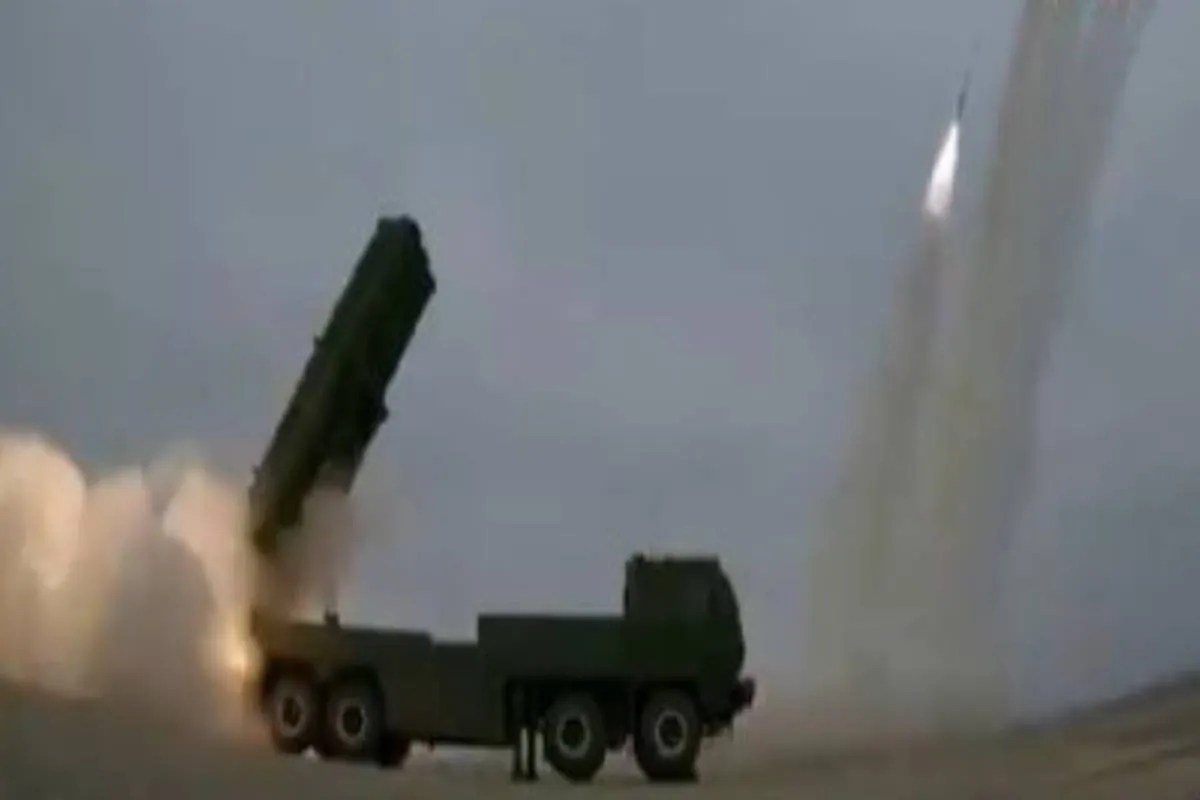
- Information Overload: The U.S. intelligence community possesses finite high-end bandwidth for real-time tracking of mobile TELs (Transporter Erector Launchers). A surge in Middle Eastern kinetic activity forces a reallocation of satellite and ELINT (Electronic Intelligence) assets away from the 38th Parallel.
- Intercept Exhaustion: The deployment of SM-3 and Patriot (PAC-3) batteries in the Middle East reduces the global ready-reserve of interceptors. North Korea’s "solid-fuel pivot" aims to exploit this by reducing the pre-launch signature, ensuring that if a conflict were to erupt, the U.S. would be fighting from a depleted inventory.
The Solid-Fuel Transformation and First-Strike Viability
The transition from liquid to solid propellants represents a fundamental shift in the Risk-Reward Calculus of North Korean missile strikes. Liquid-fueled missiles require a lengthy fueling process visible to thermal and optical satellites, creating a "Pre-emption Window."
Solid-fuel variants, such as the Hwasong-11 (KN-23/24) and the newer intermediate-range systems, eliminate this window. The propellant is cast directly into the motor casing, allowing for:
- Near-Instantaneous Launch: Time-to-fire is reduced from hours to minutes.
- Mobility as Stealth: Missiles can be stored in hardened tunnels and moved to pre-surveyed launch sites with minimal exposure.
- Trajectory Manipulation: Solid-fuel motors allow for higher pressure tolerances, facilitating depressed trajectories or "pull-up" maneuvers that complicate the terminal phase tracking for Aegis and THAAD systems.
Economic Logic of the Missile Display
North Korea utilizes these "tests" as a live-fire catalog for potential buyers. The conflict between Israel and Iran provides a unique testing ground where North Korean-derived technology (often funneled through Iranian proxies) meets Western defense systems.
The Value Proposition for Pyongyang is twofold. First, they demonstrate that their systems can penetrate high-density air defenses. Second, they secure hard currency through the sale of tactical ballistic missiles and technical assistance. In this framework, the missile launches are not "threats" in the emotional sense; they are a Marketing Function designed to prove reliability to state and non-state actors looking for cost-effective asymmetric tools against superior air powers.
Strategic Decoupling and the US Security Umbrella
The ultimate objective of North Korea’s intercontinental ballistic missile (ICBM) program—specifically the Hwasong-17 and Hwasong-18—is Strategic Decoupling. This is the process of making the cost of defending Seoul or Tokyo so high that the United States is forced to reconsider its alliance commitments.
- The San Francisco Logic: If Pyongyang can credibly threaten a nuclear strike on a major U.S. city, would Washington risk San Francisco to save Seoul? By testing during a period of global instability, Kim Jong Un reinforces the perception that the U.S. is overextended.
- The Multi-Vector Pressure Point: By targeting "America" in its rhetoric while firing toward the Sea of Japan, North Korea forces a three-way coordination challenge between Washington, Tokyo, and Seoul. Internal political friction within these alliances regarding the "proportionality" of a response is North Korea’s most effective weapon.
The Asymmetric Cost Function
The cost of a North Korean missile test is negligible compared to the cost of the defensive response.
- Pyongyang’s Cost: Mass-produced steel, domestic chemical propellants, and labor.
- Washington’s Cost: High-alert status for carrier strike groups, fuel for continuous CAP (Combat Air Patrol) flights, and the multi-million dollar price tag of a single interceptor missile.
This imbalance creates an Economic Attrition model. North Korea does not need to win a war; it only needs to make the maintenance of "Peace through Strength" prohibitively expensive for the West during an inflationary and politically polarized era.
Technological Convergence with Iran
A critical overlooked factor is the Technical Feedback Loop between Tehran and Pyongyang. When Iran launches a strike against Israel, North Korea monitors the performance of the air defense response.
- Data Harvesting: If Iranian missiles (many based on North Korean No-dong designs) fail to penetrate, North Korea iterates on the design—improving decoys, chaff, or terminal velocity.
- Collaborative R&D: The "Janggun-class" logic suggests that breakthroughs in North Korean solid-fuel motors likely find their way into Iranian IRBM programs, and vice versa.
Limitations of the Strategy
Despite the aggressive posture, North Korea faces systemic bottlenecks. The Quality Control Threshold remains unproven in a sustained conflict scenario. While a single "parade" missile may function perfectly, the ability of North Korean industry to maintain high tolerances across mass production is questionable. Furthermore, their reliance on mobile launchers is limited by the physical infrastructure of the North Korean road network, which creates predictable "kill zones" for specialized anti-TEL units.
The Strategic play
The United States must move beyond a "Reactive Sanctions" model, which has reached a point of diminishing returns. The move is a Counter-Asymmetric Escalation: shifting the focus from intercepting missiles to degrading the command-and-control nodes and the specialized chemical facilities required for solid-propellant production.
To neutralize the current North Korean pivot, the U.S. must decouple its Asia-Pacific posture from the Middle Eastern theater by accelerating the deployment of autonomous, low-cost "attritable" sensor networks in the Sea of Japan. This reduces the reliance on high-demand satellite assets and signals to Pyongyang that the "Resource Dilution" window is closed. Simultaneously, the focus must shift to the maritime interdiction of technical advisors and specialized components, targeting the human capital that facilitates the Iran-DPRK technological exchange. This is the only way to break the cycle of opportunistic escalation.