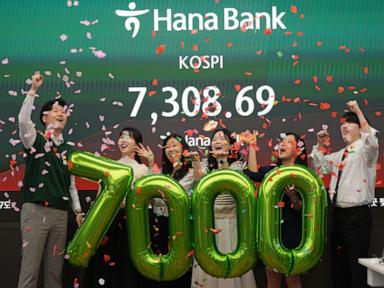
In a dimly lit corner of a Yeouido office, the air smells of ozone and stale coffee. Min-jun stares at a screen that glows with a feverish intensity. He isn't a high-frequency trader or a hedge fund titan. He is an ordinary man with a modest savings account and a sudden, clutching sense that the ground beneath his feet has shifted. On his monitor, the Kospi—South Korea’s benchmark index—is doing something it has rarely done in its storied, volatile history. It is climbing. Not a crawl, but a steady, rhythmic ascent toward a record-breaking peak, fueled by a force that feels more like alchemy than arithmetic.
The charts are clear. Foreign investors are pouring money into the peninsula at a rate that suggests a gold rush. But this isn't about gold. It’s about sand, etched with light and imbued with the closest thing to digital consciousness we have ever seen. The AI boom has arrived in Seoul, and it has brought a tidal wave of capital with it.
The Great Migration of Capital
For years, South Korea was the "undervalued" market. Analysts spoke of the "Korea Discount," a stubborn ceiling on stock prices caused by opaque corporate governance and the looming shadow of geopolitical tension. To the global investor, the Kospi was a reliable utility—steady, necessary, but unexciting.
Then the chips changed everything.
Consider the journey of a single HBM3E chip. High Bandwidth Memory is the circulatory system of the modern artificial intelligence server. Without it, the sophisticated processors designed by giants like Nvidia would be gasping for data, unable to process the billions of parameters required to generate a simple sentence or a line of code. South Korea happens to be the world's primary forge for this specific, precious commodity.
When the world realized that AI wasn't just a seasonal trend but a fundamental reordering of human productivity, eyes turned to SK Hynix and Samsung Electronics. These are no longer just hardware companies; they are the gatekeepers of the new era. In the first half of the year, foreign buying of South Korean shares hit a record high, surpassing 23 trillion won. That isn't just a number on a balance sheet. It is a massive, collective bet on the future of human intelligence.
The Weight of the Machine
To understand why this rally feels different, we have to look past the ticker symbols. Imagine a manufacturing floor in Cheongju. The precision required to build these memory stacks is so minute that a single speck of dust is a catastrophic failure. The workers here operate in a state of clinical perfection. Their labor is the silent engine behind the soaring stock prices.
When a pension fund in London or a retail trader in New York buys into the Kospi, they are buying a piece of this silence. They are betting that the demand for generative AI will continue to outstrip the physical capacity to build it.
There is a tension here, though. A nervousness. Markets that rise on the back of a single narrative are fragile things. If the AI "bubble" were to show even a hairline fracture, the retreat would be just as fast as the advance. Min-jun feels this. He sees his portfolio green for the first time in eighteen months, yet he hesitates to celebrate. He remembers the dot-com crash. He remembers the 2008 shudder.
But the logic of this rally is grounded in hardware, not just hope. Unlike the ephemeral promises of the early internet, this growth is built on physical infrastructure. Data centers are being constructed out of steel and concrete. They require cooling. They require power. Most of all, they require the silicon being poured in Korean foundries.
The Ripple Effect
The record-breaking heights of the Kospi aren't just making the rich wealthier. They are altering the gravity of the local economy. When the "big two"—Samsung and Hynix—thrive, a massive ecosystem of suppliers, packaging firms, and logistics providers thrives with them.
The invisible stakes are found in the cafes and small businesses surrounding these industrial hubs. When the tech shares rally, confidence trickles down. A local restaurant owner sees more tables filled. A real estate agent sees a surge in interest for apartments near the tech corridors. The stock market is often criticized for being decoupled from "real life," but in a nation whose identity is so inextricably linked to its technological prowess, the Kospi is a national pulse.
However, there is a shadow to this brilliance. The rally has been heavily concentrated. While the tech titans soar, other sectors—retail, construction, traditional manufacturing—often find themselves left in the cold. It is a lopsided victory. For every investor like Min-jun who happened to hold the right shares, there are thousands of others watching the "record-breaking" headlines from the sidelines, their own bank accounts stagnant.
The Global Tug of War
Why is the money coming from outside? For months, the South Korean government has been pushing the "Corporate Value-up Program." It’s an attempt to force companies to be more shareholder-friendly, to pay higher dividends, and to be more transparent.
Foreign investors are notoriously cynical. They have heard these promises before. But the convergence of this regulatory push with the AI explosion created a "perfect storm" of incentive. Suddenly, the Korea Discount looked like a once-in-a-generation buying opportunity.
It is a strange irony. The very machines—the AI models—that these chips are being built to power are likely the ones being used by Wall Street firms to analyze the data and execute the trades that are driving the Kospi higher. It is a self-reinforcing loop of silicon and logic.
The Human Cost of the High
Min-jun eventually closes his laptop. The record has been set. The news cycles will move on to the next number, the next milestone. But the pressure remains.
For the engineers in Suwon, the rally means more overtime. It means the race to develop the next generation of HBM—HBM4—is no longer just a corporate goal; it is a matter of national economic security. The world is leaning on their shoulders, demanding more speed, more capacity, more efficiency.
We often talk about "the market" as if it were a weather pattern, something that happens to us. We forget that the market is just a collection of human desires, fears, and efforts. The Kospi’s record high is a testament to a nation that has spent decades preparing for a moment it couldn't have fully predicted.
The chips are down, but in Seoul, the chips are also up.
The screen in the Yeouido office goes dark, but the machines in the factories never stop. They hum with a low, constant vibration, a mechanical heartbeat that echoes the frantic tapping of traders halfway across the globe. We have entered a period where the line between human ambition and machine capability has blurred into a single, ascending line on a graph.
The record has been broken, yet the hunger for more remains entirely, perhaps dangerously, human.