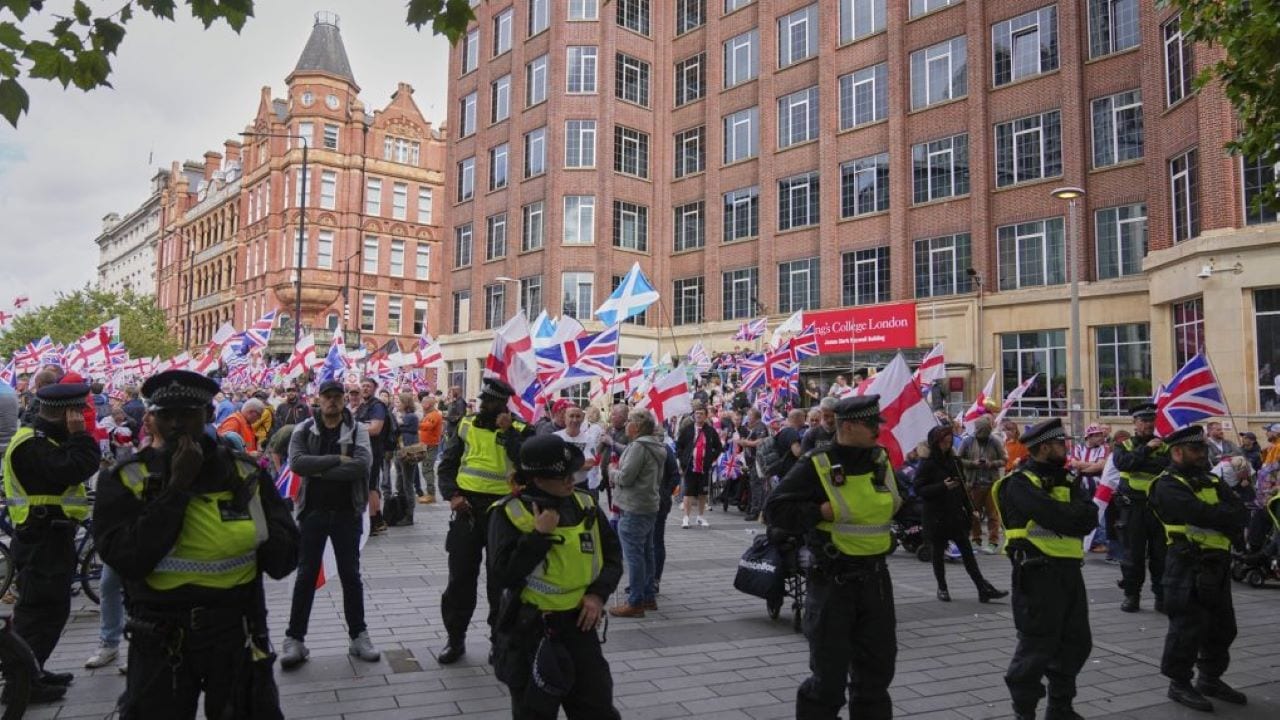
The air in central London doesn’t usually smell like this. Normally, it is a soup of diesel exhaust and damp pavement, the sterile scent of a city in a hurry. But today, it smells of damp wool, cheap coffee, and the sharp, metallic tang of adrenaline. It is a cold Saturday, the kind that bites through a denim jacket, yet no one seems to be shivering.
I am standing near the base of Nelson’s Column, watching a sea of faces pour out of the Underground like water from a burst pipe. They aren't the usual weekend tourists clutching overpriced maps. These are teachers from Leeds, retirees from Cornwall, and students who skipped their lectures to carry cardboard signs with edges softened by the drizzle. They have come to march against a ghost that has taken on a very solid form: the rapid, unapologetic rise of the far-right across the continent and within their own borders. For an alternative view, check out: this related article.
There is a specific frequency to a crowd this size. It isn't just noise; it’s a vibration you feel in your solar plexus. When fifty thousand people decide to move in unison, the ground forgets how to be still.
The Anatomy of a Fear
To understand why a nurse from Croydon would spend her only day off walking six miles in the rain, you have to look past the slogans. The headlines speak of "political shifts" and "electoral swings," but those are bloodless terms. They don't capture the dinner-table anxiety of a family watching the news and wondering if their neighbor’s newfound rhetoric is a phase or a warning. Further analysis on this matter has been published by NPR.
Consider a hypothetical man named Elias. He’s third-generation British, a pharmacist who likes cricket and complains about the price of butter. For decades, he felt like a thread woven tightly into the fabric of his town. But lately, the television tells him that people who look like him are "invaders." He sees politicians using language that was once relegated to the dark, dusty corners of the internet, now polished and presented on prime-time news. Elias isn't here today because he loves hiking through Westminster; he’s here because he’s terrified that the fabric is unravelling.
The "rise of the right" is often framed as a reaction to economic hardship, and the data supports this. When the cost of a loaf of bread climbs faster than a paycheck, people look for someone to blame. It is a historical reflex. In the 1930s, the script was written in black and white; today, it’s high-definition and algorithmically optimized. The facts show a direct correlation between austerity measures and the surge in populist voting patterns. When public services crumble, the promise of a "strong leader" who will "protect our own" starts to sound less like a threat and more like a life raft to those who feel they are drowning.
The Language of the Street
The marchers move toward Whitehall, a canyon of grey stone and power. The police line the route, their yellow jackets the only bright spots in a muted palette. I talk to a woman named Sarah, who is holding a sign that simply says Not Again.
"My grandfather fought in 1944," she tells me, her voice barely audible over a drum troupe nearby. "He didn't talk about it much, but he told me once that it didn't start with camps. It started with polite conversations about who belonged and who didn't. I feel like we’re having those polite conversations again."
Her fear isn't hyperbole; it’s a recognition of a pattern. The modern far-right has traded the jackboots for slim-fit suits and polished social media feeds. They don't always talk about hate; they talk about "heritage" and "common sense." It’s a rebranding exercise that has been remarkably successful. In countries across Europe, parties that were once fringe are now kingmakers. They have mastered the art of the grievance, turning legitimate frustrations about housing and healthcare into a weapon against the "other."
This isn't a localized British phenomenon. The march in London is a mirror held up to a global movement. From the borders of Poland to the suburbs of Paris, the center is struggling to hold. The protesters today know that London is just one front in a much larger, much quieter war for the soul of the democratic project.
The Invisible Stakes
What is actually at risk? It’s easy to say "democracy," but that’s a big, heavy word that has lost its shape. The real stakes are smaller, more intimate.
It’s the right of a teenager to walk home without being told to "go back where they came from." It’s the ability of a library to stock books that challenge the status quo without fear of being defunded. It’s the basic, unspoken agreement that we solve our problems through debate rather than demonization.
When the political right leans into ethno-nationalism, these small things are the first to go. The rhetoric acts like a solvent, slowly dissolving the trust between strangers. You start to look at the person sitting across from you on the bus not as a fellow commuter, but as a data point in a demographic shift.
The marchers recognize that once that trust is gone, you can't just buy it back at the store. It takes generations to build and only a few loud years to destroy.
The Rhythm of Resistance
As the crowd reaches Parliament Square, the rain turns from a drizzle to a steady downpour. Nobody leaves. Umbrellas bloom like nylon flowers, overlapping to create a makeshift roof.
There is a strange kind of joy here, despite the grim subject matter. It’s the joy of realizing you aren't alone in your unease. For months, these people have been doom-scrolling in their living rooms, feeling the weight of a changing political climate pressing down on them. Now, they are standing next to fifty thousand other people who feel the exact same weight.
A speaker on a distant stage mentions the recent election results in neighboring countries. A collective groan ripples through the crowd, followed by a chant that shakes the windows of the Treasury. It isn't a chant of hate; it’s a chant of presence. We are here. We see you. We do not agree.
The statistics of the far-right’s rise are cold and hard. They show seats won, percentages gained, and budgets shifted. But those numbers don't account for the friction of the street. They don't account for the sheer physical effort of thousands of people refusing to stay home.
The Long Walk Back
Eventually, the speeches end. The crowd begins to thin, bleeding back into the side streets and tube stations. The energy doesn't disappear; it just changes state. It becomes conversations in pubs, posts on social media, and plans for the next local meeting.
The far-right didn't rise overnight, and a single march won't make it vanish. It is a slow-moving tide, driven by deep-seated economic anxieties and a masterful manipulation of identity. To push it back requires more than just walking; it requires a counter-narrative that is more compelling than fear. It requires proving that a diverse, messy democracy can actually deliver the bread and the roses it promises.
As I walk away from the square, I see a discarded sign leaning against a lamp post. The ink is running, the letters blurring into a grey smudge. The "rise" of any movement feels inevitable until it hits a wall of people who simply refuse to move.
The city begins to reclaim its usual scent. The diesel returns. The sterile hurry resumes. But on the pavement, thousands of muddy footprints remain, a messy, temporary map of a Saturday when a city decided to speak back to the darkness.
The boots have stopped moving, but the vibration is still there. You just have to listen for it.