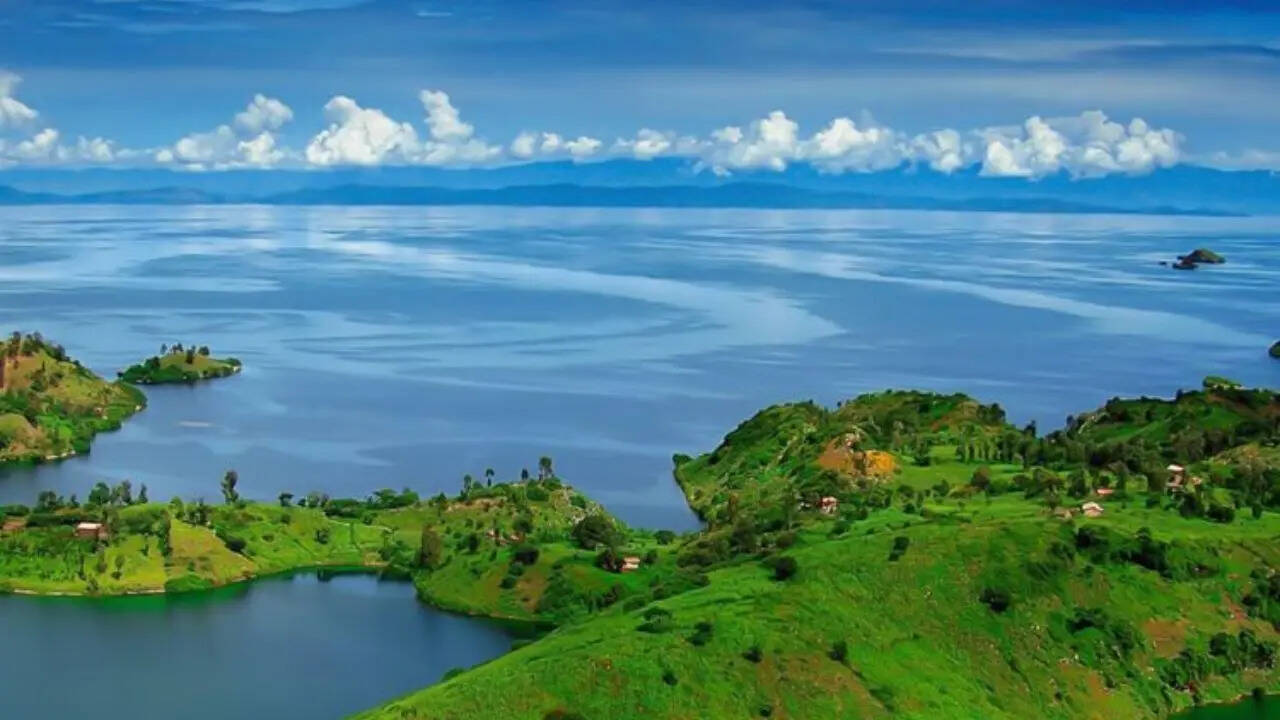
Lake Kivu does not present a vague or mystical threat; it functions as a highly pressurized, self-charging thermodynamic battery currently operating at approximately 60% of its maximum gas storage capacity. Located within the western branch of the East African Rift System, this water body holds an estimated 300 cubic kilometers of dissolved carbon dioxide ($CO_2$) and 60 cubic kilometers of dissolved methane ($CH_4$). Unlike standard lacustrine environments that undergo seasonal convective mixing, Lake Kivu is permanently stratified. If this structural stability fails, the resulting limnic eruption will release between 2 and 6 gigatonnes of carbon in a 24-hour window—an volume equivalent to roughly 5% to 15% of annual global industrial emissions—while creating a localized asphyxiation zone and a highly combustible air-gas boundary layer.
To evaluate the operational risk to the 2 million people living along its shores, the lake must be analyzed not as a passive geographic feature, but as a dynamic mechanical system governed by distinct physical, chemical, and industrial variables.
The Stratification Architecture: Density vs. Buoyancy
The stability of Lake Kivu relies on a hyper-stratified fluid column where density gradients counteract the normal thermal forces that cause water to circulate. The lake is divided into two primary zones separated by a major density barrier known as the main chemocline, which sits roughly 250 meters below the surface.
+-------------------------------------------------------+  0m
|  Mixolimnion (Epilimnion)                             |
|  - Low salinity, low density, oxic                    |
|  - Regular seasonal convective mixing                  |
|  - Depth: ~0m to 60m                                  |
+-------------------------------------------------------+  60m
:  Transition Zones / Minor Chemoclines                :
.........................................................  250m
:  Main Chemocline (The Density Barrier)               :
+-------------------------------------------------------+  260m
|  Monimolimnion (Hypolimnion)                         |
|  - Subsurface hydrothermal input                     |
|  - High salinity, high dissolved gas load, anoxic     |
|  - Total dissolved volume: 300 km³ CO₂, 60 km³ CH₄    |
|  - High density prevents vertical movement            |
+-------------------------------------------------------+  485m (Floor)
The upper zone, or mixolimnion, extends down to approximately 60 meters. This layer features lower salinity, lower density, and undergoes regular mixing driven by wind and seasonal temperature changes. Below this layer sits the monimolimnion, an anoxic zone extending to the lake bed at 485 meters. The monimolimnion remains isolated due to two reinforcing factors:
- Hydrothermal Salinity Loading: Deep sub-lacustrine springs constantly inject heavy, mineral-rich brines containing sodium, magnesium, and calcium into the deep water. This creates a distinct salinity gradient that grows denser with depth.
- The Dissolved Gas Reservoir: $CO_2$ enters the lake bed through volcanic outgassing, where anaerobic archaebacteria process a portion of it into $CH_4$. Because gas solubility scales linearly with hydrostatic pressure according to Henry’s Law, the extreme pressure at depth keeps these massive volumes locked in solution.
This dissolved gas load actually increases the bulk density of the deep water, creating a stable, heavy fluid layer at the bottom. As long as the downward force of this dense, salty water outweighs the upward buoyant force generated by geothermal heating from below, the lake remains stratified and quiet.
The Mechanics of Kinetic Overturn
A limnic eruption is not a volcanic explosion, but an abrupt, self-reinforcing phase change. The underlying mechanism is identical to opening a warm, agitated bottle of carbonated soda. The transition from static containment to runaway eruption requires a specific sequence of triggers and mechanical feedback loops.
The Saturation Threshold
The long-term risk profile is dictated by the total dissolved gas pressure ($TDGP$). If $TDGP$ matches the local hydrostatic pressure at any given depth, the water reaches 100% saturation. At this margin, gas cannot remain dissolved; it transitions into a gas phase, forming physical bubbles.
While recent laser spectrometry and membrane inlet data indicate that the deep layers are near a steady state rather than rising exponentially, the system remains vulnerable to external kinetic disruptions that can force water upward before it hits full saturation.
The Trigger Mechanisms
An involuntary vertical displacement can bypass a stable saturation profile via three distinct physical triggers:
- Volcanic Magma Intrusion: Mount Nyiragongo and the Virunga volcanic field border the northern shore. A major sub-lacustrine basaltic lava flow injecting millions of cubic meters of molten rock into the monimolimnion would rapidly heat the deep water. This thermal energy would drastically drop the solubility of the dissolved gases while creating localized, highly buoyant thermal plumes.
- Seismic Rupture: The active rifting floor is prone to earthquakes. A major seismic event can generate large internal waves along the deep chemoclines, pushing large volumes of gas-rich deep water upward across the density boundary.
- Climatic Evaporative Forcing: Long-term regional droughts evaporate the upper mixolimnion. Shrinking the top layer reduces the total weight pressing down on the deep water. This drop in hydrostatic pressure effectively moves the deep water closer to its flash-evaporation threshold without requiring any physical movement.
The Runaway Feedback Loop
The moment an external trigger shifts a parcel of gas-saturated water upward by even a few meters, the hydrostatic pressure acting on that water drops. This drop causes the dissolved $CH_4$ and $CO_2$ to rapidly come out of solution and form bubbles.
Because methane is significantly less soluble in water than carbon dioxide, it bubbles out first, acting as the primary mechanical driver of the eruption.
As these bubbles form, they lower the density of the surrounding water column, making it highly buoyant. This buoyant fluid rushes upward, pulling more gas-saturated water from the depths along with it. This creates a powerful upward siphon that quickly expands into a massive, degassing plume.
Quantifying the Catastrophe Portfolio
The atmospheric and physical hazards of a full-scale overturn at Lake Kivu scale exponentially compared to the historic 1986 Lake Nyos event in Cameroon, which killed nearly 1,800 people. Kivu contains roughly 2,000 times the gas volume of Nyos, and its surrounding population density is orders of magnitude higher.
Phase 1: The Lacustrine Tsunami
The violent conversion of dissolved gas into expanding gas bubbles causes a rapid volume expansion within the lake basin. This displacement generates lake tsunamis, with estimated wave heights reaching 5 to 10 meters. These waves would hit the major municipal centers of Goma in the Democratic Republic of the Congo and Rubavu in Rwanda within minutes, destroying shoreline infrastructure.
Phase 2: The Asphyxiation Zone
Because carbon dioxide is roughly 1.5 times denser than ambient air, the erupted gas cloud will stay low to the ground, forming a heavy blanket over the topography. Locally referred to as a mazuku (Swahili for "evil wind"), this toxic cloud would displace oxygen entirely across low-lying valleys. A $CO_2$ concentration above 10% causes rapid unconsciousness and asphyxiation within minutes. Given the local topography, a major outgassing event threatens up to two million human lives across the basin.
Phase 3: The Methane Combustion Vector
Unlike Lake Nyos, which contained only non-combustible $CO_2$, Lake Kivu’s air-gas mixture would include up to 20% methane. While pure methane will not ignite under water, a massive release would mix with atmospheric oxygen at the surface.
The total chemical energy stored as dissolved methane in the lake is estimated to be roughly equivalent to one gigaton of TNT. Any ignition source—whether from local electrical grids, open cooking fires, or nearby volcanic activity—could trigger widespread fuel-air explosions and massive firestorms across urban areas.
Industrial Extraction: Mitigation vs. Destabilization
The primary strategy to mitigate this risk is industrial degassing, a process designed to lower the lake's internal pressure by actively removing the dissolved methane and utilizing it for commercial electrical power generation. This approach is currently operational via projects like KivuWatt. However, the fluid dynamics of this extraction process present a delicate trade-off between long-term risk reduction and short-term systemic destabilization.
       [ Power Station ] <--- Purified CH₄ (Fuel)
              ^
              | (Subsurface Pipeline)
              |
      ================== [ Extraction Barge ] ==================
         |                                           ||
         | (Uptake Pipe)                             || (Deep Discharge)
         |                                           ||
         |                                           \/
  +-------------------------------------------------------------+
  | Mixolimnion                                                 |
  |                                                             |
  + - - - - - - - - - - - - - - - - - - - - - - - - - - - - - - + 250m
  | Monimolimnion                                               |
  |                                 [Plume Turbulence Risk]     |
  |      [Gas Siphon]               (If discharged too high,   |
  |           ||                    destabilizes the gradient)   |
  |           ||                                 ||             |
  |           \/                                 \/             |
The Auto-Siphon Mechanism
Industrial extraction leverages the lake's unique chemistry through an auto-siphon design. Deep, gas-rich water is pumped up via a vertical pipe. As the water rises and the hydrostatic pressure drops, the dissolved methane bubbles out of solution naturally within the pipe.
These bubbles create a lifting effect, pulling the remaining water upward without requiring continuous mechanical pumping. The mixture is collected by an offshore surface barge, where the methane is separated from the carbon dioxide and water, cleaned, and piped to an onshore power station.
The Density Plume Dilemma
The critical engineering bottleneck lies in how the processed, degassed water is returned to the lake. To maintain the lake's structural stability, this water must be reinjected at a depth that matches its post-extraction density.
If this degassed water is discharged too high up in the fluid column, it creates a downward-sinking plume because it is colder and saltier than the surrounding water. This downward movement generates vertical shear forces and turbulence that can erode the delicate density boundaries of the main chemocline.
Conversely, if the water is returned with residual gas or at incorrect depths, it can trigger localized upward upwelling. This vertical mixing can inadvertently accelerate the very limnic eruption the system is designed to prevent.
Strategic Action Plan
To transition Lake Kivu from a systemic regional threat to a stable industrial resource, international stakeholders, energy operators, and regional governments must pivot away from slow, uncoordinated extraction toward a tightly regulated, high-precision engineering framework.
- Enforce Strict Reinjection Depth Corridors: Regulators must mandate that all commercial extraction platforms utilize deep-water discharge systems that return degassed brine directly back to the lower monimolimnion (below 250 meters). This prevents the vertical mixing and plume turbulence associated with shallow or mid-depth dumping.
- Deploy an Interconnected Real-Time Sensor Array: Implement an integrated network of total dissolved gas pressure ($TDGP$) sensors, acoustic Doppler current profilers ($ADCP$), and seismic monitors across the entire lake basin. This system will provide automated, early-warning telemetry on chemocline erosion, internal wave anomalies, and sudden changes in gas saturation.
- Scale High-Density Extraction Frameworks Safely: Current commercial operations process only a fraction of a percent of the lake's gas load each year, meaning it would take over a century to significantly lower the eruption risk. Governments should incentivize rapid scaling of extraction facilities, provided that operators adhere to strict, audited thermodynamic safety standards. Accelerating the safe removal of methane directly lowers the internal pressure of the reservoir, systematically defusing the lake's explosive potential while providing critical, baseload electricity to the regional grid.