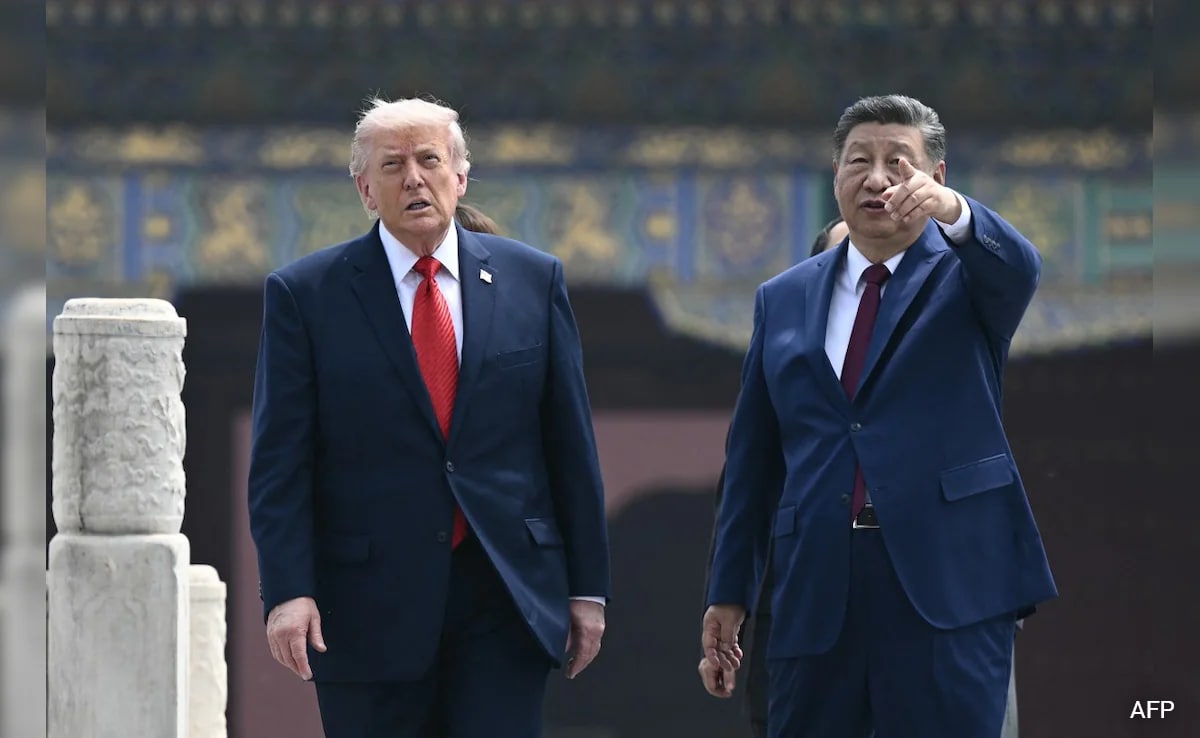
Xi Jinping is a student of history, but he is also a master of the stage. On May 14, 2026, within the echoing halls of the Great Hall of the People, the Chinese leader looked Donald Trump in the eye and invoked the Thucydides Trap. It was a calculated move designed to frame the modern struggle for global hegemony as an ancient, almost tragic inevitability. By asking if the two nations could avoid the "rise of one and the fear of the other" that traditionally leads to war, Xi wasn't just talking about history. He was setting a psychological snare.
The "trap" suggests that conflict is a structural byproduct of shifting power dynamics. But look closer at the 2026 Beijing Summit and you see a far more transactional, cold-blooded reality. This isn't about two civilizations drifting toward a preordained clash. It is about two leaders—one an unpredictable populist and the other a disciplined autocrat—trying to manage a messy, high-stakes divorce without burning down the house they both still live in.
The Illusion of Historical Inevitability
The Thucydides Trap has become the favorite intellectual crutch of the foreign policy establishment. Popularized by Graham Allison, it cites 16 historical cases where a rising power challenged a ruling one, resulting in war 12 times. Beijing loves this narrative because it places the burden of peace on the "ruling" power—the United States. The subtext is clear: if war happens, it is because Washington was too afraid to accommodate China's rightful ascent.
During these talks, Xi proposed a new framework: "constructive strategic stability." It sounds sophisticated. In practice, it is a request for a "controlled" competition where the U.S. stops interfering with China’s domestic red lines—specifically Taiwan and high-tech industrial policy—in exchange for a quieter trade environment. Xi is banking on the idea that Trump, ever the dealmaker, prefers a stable market and a flashy "win" over a long-term ideological crusade.
But the Thucydides analogy is fundamentally flawed. Unlike Sparta and Athens, the U.S. and China are lashed together by a global financial system that didn't exist in the 5th century BCE. A full-scale kinetic war would not just be a military catastrophe; it would be an immediate, total economic collapse for both sides.
The Taiwan Red Line and the Price of Miscalculation
If there is a geographic center to this "trap," it is the 100 miles of water separating mainland China from Taiwan. During the summit, Xi’s rhetoric took a sharper turn. He described "Taiwan independence" and peace as being "as irreconcilable as fire and water." This wasn't just a boilerplate warning. It was a direct response to the $11 billion arms sale the U.S. State Department notified to Congress in late 2025.
Trump’s approach to Taiwan has always been a wildcard. While his predecessors treated the island as a democratic bastion to be defended at all costs, Trump has historically viewed it through a more transactional lens. Beijing knows this. By invoking the Thucydides Trap, Xi is testing whether Trump will trade security guarantees for Taiwan in exchange for massive agricultural purchases or a "balanced" trade agreement that helps the GOP in the 2026 midterms.
The danger isn't a planned invasion tomorrow. The danger is strategic miscalculation. If Beijing believes Trump is willing to sell out Taipei for a trade deal, they might push a boundary. If Trump believes his personal "best relationship" with Xi gives him a pass to keep arming the island without consequence, he is mistaken. The trap isn't set by history; it’s set by the assumption that the other side is bluffing.
The Trade Truce and the Rare Earth Weapon
While the high-minded talk of ancient Greece dominated the headlines, the real work happened in the side rooms where trade teams hammered out the "generally balanced" outcomes Xi mentioned. In late 2025, China tightened export controls on rare earth elements—the lifeblood of the modern EV and defense industries. It was a classic "shot across the bow."
The suspension of those controls just before the summit was the carrot. The stick remains firmly in Xi’s hand.
China is no longer the "factory of the world" looking for a seat at the table. It is an industrial superpower that understands exactly where the Western supply chain is most fragile. The 2026 trade "stabilization" isn't a return to the free-trade era of the early 2000s. It is a tactical pause.
- Technology Sovereignty: China is doubling down on domestic chips and AI safety, seeking to decouple from U.S. dependencies before the next round of sanctions.
- The TikTok Model: The January 2026 joint venture for TikTok—where ByteDance kept a minority stake while Oracle took over U.S. data—is being eyed as a blueprint for other tech sectors.
- Market Access: Beijing is opening its doors just wide enough to keep U.S. CEOs in the room, using them as a lobby against Washington hawks.
The Fragility of Personal Diplomacy
The most jarring aspect of the summit was the tonal whiplash. Trump described Xi as a "great leader" and claimed they have the "best relationship" of any two presidents in history. This is the same leader who, months ago, was threatening sweeping new tariffs that were only derailed by a 2026 Supreme Court ruling on the International Emergency Economic Powers Act.
Xi, by contrast, favors meticulous preparation over Trump’s improvisational style. He knows that a compliment from the American president can be retracted in a midnight social media post. For Beijing, this summit isn't about building trust—it's about building predictability.
They are trying to institutionalize communication channels. Military-to-military hotlines are being reopened not out of friendship, but out of fear. When two nuclear-armed superpowers are playing chicken in the South China Sea, the person who answers the phone matters more than the person who signs the trade deal.
The Real Crisis Is Domestic
The irony of the Thucydides Trap is that both leaders are currently more haunted by their own internal demons than by each other.
Xi is dealing with a Chinese economy that is "growing" on paper but struggling with high youth unemployment and a cooling property sector. He needs the U.S. market to stay open to buy Chinese exports. Trump is staring down a midterm election year where inflation and high energy prices are the only metrics that truly matter to his base.
A trade war in 2026 would be political suicide for the White House and a social stability nightmare for the Kremlin-aligned factions in Beijing. This summit was a performance of strength to mask mutual vulnerability.
The Thucydides Trap is a useful metaphor for a speech, but it’s a poor guide for policy. History doesn't repeat itself; it's the people who forget history that do. Xi and Trump aren't trapped by the 5th century BCE. They are trapped by the 21st-century reality that they cannot live with each other, and they cannot survive without each other.
The "landmark year" Xi promised isn't the start of a new era of peace. It is the beginning of a more sophisticated, more dangerous phase of managed decline in the world's most important relationship. Watch the rare earth export dates in November 2026. That is where the talk of ancient traps ends and the reality of modern economic warfare begins.