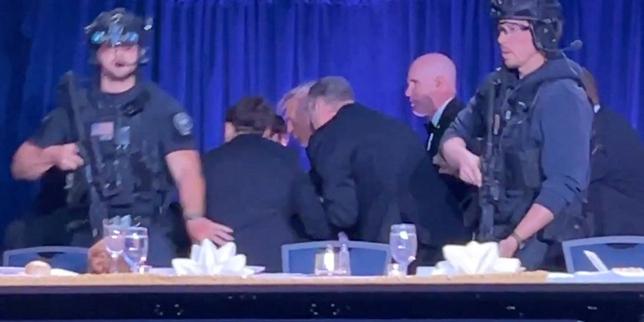
The Metropolitan Police Department's rapid classification of the White House Correspondents' Dinner shooting as the work of a lone actor serves a specific political function. It provides immediate public closure. By framing the violence as the isolated outburst of a single individual, authorities effectively shut down broader inquiries into systemic security lapses or potential radicalization networks before the forensic evidence is even fully processed. However, the reality of high-stakes protective details suggests that "lone" does not mean "unpreventable."
While the gunman acted alone in the tactical sense—pulling the trigger without a direct accomplice on-site—the breach represents a catastrophic breakdown of the multi-layered security perimeter designed to protect the President, the Vice President, and the nation’s press corps. This wasn't just a random act of violence. It was a failure of intelligence and physical hardware at one of the most guarded events on the global calendar.
The Myth of the Unpredictable Attacker
Law enforcement officials often lean on the "lone wolf" terminology because it absolves the system of oversight errors. If an attacker has no accomplices and no digital footprint, the logic goes, then no amount of surveillance could have stopped them. This is a convenient fiction. Most individuals who transition from grievance to violent action leave a trail of "leakage"—behavioral indicators that are often ignored or caught in bureaucratic red tape.
In this instance, the shooter managed to bypass the United States Secret Service (USSS) outer perimeter with a concealed weapon. To understand how this happened, we have to look at the security theater that often replaces genuine tactical rigor at high-profile Washington galas. The Hilton’s basement level, where the dinner is held, is a subterranean fortress. Yet, the chaos of thousands of guests, catering staff, and motorcade movements creates gaps that a determined individual can exploit.
Perimeters Without Depth
A standard protective detail relies on concentric circles of security. The innermost circle is the detail itself, physically shielding the VIPs. The middle circle consists of magnetometers and checkpoints. The outer circle is supposed to be the eyes and ears—undercover officers and intelligence sweeps.
The shooter didn’t need a sophisticated plan to break the inner circle. They simply found a seam in the middle. Sources close to the investigation suggest that the influx of "non-vetted" support staff and the sheer volume of equipment being moved for the television broadcast created a "blind spot" in the magnetometer coverage. When we rely on machines instead of human intuition, we invite these lapses.
The Evolution of the Threat Profile
The modern threat to public figures has shifted. We are no longer just looking for organized groups with logistical hubs. We are looking for the displaced extremist. This is someone who consumes a cocktail of disparate ideologies online, forming a personalized manifesto that doesn't fit neatly into a single FBI tracking category.
By labeling the shooter a "lone actor" within hours of the event, the MPD effectively halted the conversation about where this person was radicalized. If the shooter was radicalized in a specific online community, their "loneliness" is a technicality. They are part of a decentralized movement. Treating these shooters as vacuum-sealed anomalies prevents us from addressing the digital infrastructure that facilitates their descent into violence.
The Intelligence Gap
The Secret Service has faced mounting pressure over the last decade regarding personnel shortages and morale issues. These internal struggles have tangible consequences on the ground. A tired agent is an agent who misses a twitchy hand or a bulky jacket.
- Personnel Fatigue: Agents often work double shifts during "high-tempo" weeks like the Correspondents' Dinner.
- Technology Reliance: An over-dependence on facial recognition and sensors can lead to a lack of physical pat-downs and manual bag checks.
- Information Silos: Local police and federal agencies often fail to share low-level "nuisance" reports that, when combined, paint a picture of a looming threat.
The Logistics of a Breach
To get a firearm into the Washington Hilton during the "Nerd Prom," one must navigate a gauntlet that rivals any international airport. The shooter’s ability to do so suggests a high level of pre-attack surveillance. They likely visited the site multiple times, mapped out the shift changes of the private security contractors, and identified which side entrances were used for trash removal or floral deliveries.
This is the "how" that the official lone-actor narrative avoids. It implies a level of competence that makes the security apparatus look incompetent. It is much easier for a press secretary to say the shooter was "deranged and alone" than to admit the shooter was "methodical and exploited our known weaknesses."
The Weaponry Factor
The choice of firearm also tells a story. We aren't dealing with a long-range rifle from a nearby rooftop; this was a close-quarters engagement. This indicates a shooter who was comfortable with the idea of a "suicide mission." When an attacker does not plan for an escape, the traditional deterrents of police presence and certain capture lose all efficacy.
The security perimeter is designed to stop people who want to get away. It is remarkably poorly equipped to stop those who only want to get close.
Why the Narrative Matters Now
If we accept the "lone actor" theory at face value, we miss the opportunity to overhaul the way we protect public spaces. The Correspondents' Dinner is a symbol of the intersection of power, media, and celebrity. It is a high-value target not just for the lives it contains, but for the global message a disruption sends.
The investigation must move beyond the shooter’s identity and into the structural vulnerabilities of the venue itself. The Washington Hilton is an aging piece of architecture. Its sprawling layout and multiple levels make it a nightmare to sweep effectively. If the federal government continues to host Tier-1 events in Tier-3 facilities, this will happen again.
Beyond the Police Report
The public deserves more than a three-paragraph press release about a "troubled individual." We need a transparent audit of the Secret Service’s coordination with the MPD. We need to know why the "outer-zone" patrols failed to identify a person who clearly did not belong in the restricted staging area.
True investigative work requires us to look past the easy answers. The "lone actor" is rarely ever truly alone; they are supported by a culture of security complacency and a digital world that provides the blueprint for their rage.
The shooter may have been the only one holding the gun, but the failure to stop them was a collective effort. Every missed warning sign and every bypassed metal detector contributed to the muzzle flash in that hallway. We have to stop treating these events as lightning strikes. They are the predictable results of a security system that has become too heavy, too slow, and too reliant on its own reputation.
Fixing the perimeter requires more than just more bodies at the door. It requires a fundamental shift in how we analyze threat actors who don't belong to a traditional cell. Until we acknowledge that the "lone wolf" is a byproduct of our own systemic failures, we are simply waiting for the next breach. The solution starts with admitting that the current protective model is broken. It is time to stop hiding behind the "lone actor" label and start looking at the gaps in the fence.