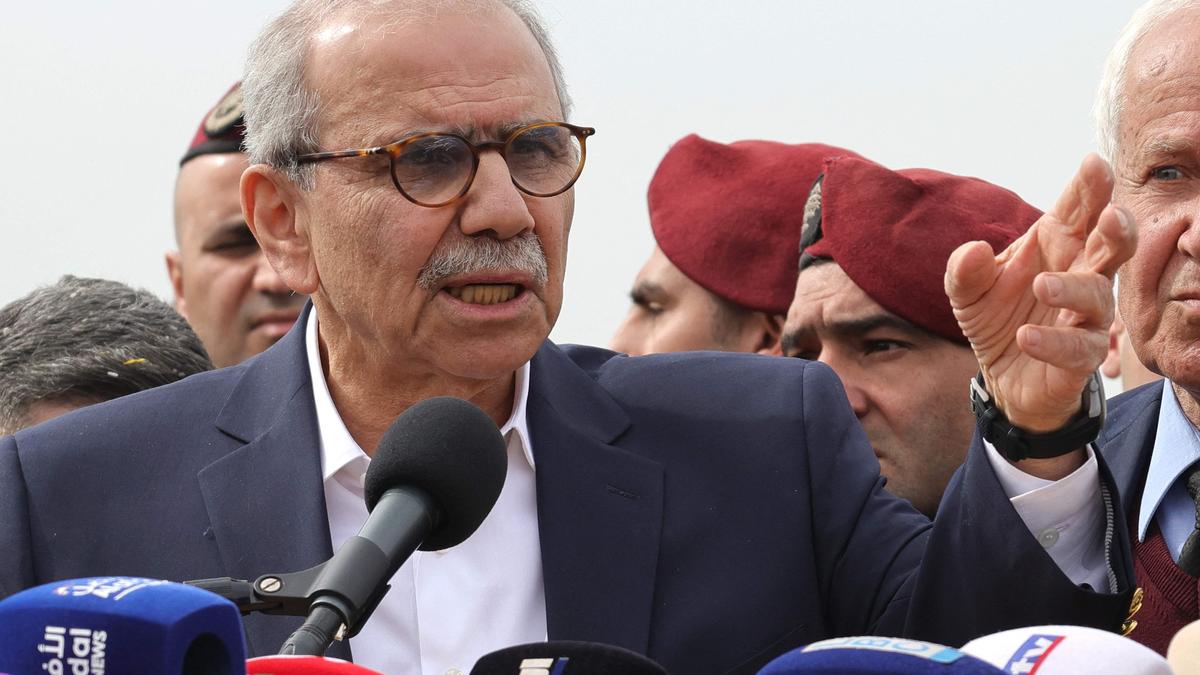
The headlines are predictable, lazy, and dangerously wrong. When the Lebanese Prime Minister suggests that the Iranian Revolutionary Guard Corps (IRGC) is "commanding" operations on the ground in Beirut or Southern Lebanon, he isn't providing a breakthrough insight. He is performing a tired piece of political theater designed to mask a much darker reality: the total evaporation of the Lebanese state.
Stop looking for a puppet master in Tehran to explain every tactical shift. To believe that Hezbollah is merely a franchise following faxed orders from an IRGC general is to fundamentally misunderstand how modern asymmetric warfare and regional power dynamics actually function. It is a comforting lie for Western diplomats because it suggests that if you just "cut the head off the snake" in Iran, the Lebanese problem vanishes.
It won't. Hezbollah is not a foreign body. It is the most efficient, disciplined, and heavily armed organ of the Lebanese body politic.
The Sovereignty Smokescreen
The "command and control" narrative serves a specific purpose for the Lebanese government. By blaming Tehran for every missile launched or every tactical maneuver executed, the Prime Minister grants himself a get-out-of-jail-free card. It allows the remnants of the Lebanese state to claim victimhood rather than complicity.
If Iran is in charge, then Lebanon is occupied. If Lebanon is occupied, then the Lebanese government isn't responsible for the war on its doorstep.
This is a logical fallacy that ignores forty years of institutional integration. Hezbollah doesn't need an Iranian colonel to tell them where to place a battery. They have spent decades building a domestic military-industrial complex that is more competent than the actual Lebanese Armed Forces (LAF).
I have seen this pattern across multiple conflict zones. When a state fails to provide security, infrastructure, or a cohesive national identity, a sub-state actor fills the vacuum. Calling that actor a "proxy" is a semantic trick to avoid admitting that the original state no longer exists in any meaningful way.
The "Proxy" Fallacy
The term "proxy" implies a one-way street of instruction. It suggests a lack of agency.
In reality, the relationship between the IRGC and Hezbollah is a high-level strategic partnership, not a supervisor-employee dynamic. Hezbollah provides the IRGC with something it can't buy: battle-hardened Arab boots on the ground with local linguistic and cultural fluency.
- Local Intelligence: No Iranian general knows the hills of the South better than a local commander who grew up there.
- Political Cover: Hezbollah operates within a parliament. They hold portfolios. They manage trash collection and hospitals.
- Tactical Autonomy: Modern warfare, especially against a technologically superior foe like Israel, requires decentralized decision-making. If every decision had to be routed through a command center in Tehran, the organization would have been dismantled decades ago.
The "commanding operations" narrative falls apart when you look at the speed of engagement. Tactical decisions are made in seconds, not through a bureaucratic chain of command stretching across the Middle East.
The Failure of the LAF and Western Funding
For years, the United States and its allies have poured billions into the Lebanese Armed Forces (LAF). The logic was simple: build a strong national army to counter the "militia."
It was a catastrophic waste of capital.
The LAF is not a counterweight to Hezbollah; it is a cohabitant. In many cases, the two organizations share intelligence and coordinate movements. By funding the LAF while Hezbollah effectively controls the borders and the internal security apparatus, the West has inadvertently subsidized the environment in which Hezbollah thrives.
We are paying for the guard rails of a house that Hezbollah owns.
The Real Power Mechanic: Ideological Alignment vs. Military Command
Critics point to the presence of IRGC advisors as "proof" of Iranian command. This is amateur-hour analysis.
The United States has advisors in dozens of countries. Does that mean the Pentagon "commands" the domestic policy of every nation where a Green Beret is stationed? Of course not.
The IRGC provides the hardware, the high-level training, and the strategic "north star." But the operation is Lebanese. The blood is Lebanese. The political consequences are Lebanese.
By hyper-focusing on the Iranian connection, the international community ignores the domestic failures that made Hezbollah's rise inevitable. You cannot solve a domestic insurgency through a foreign policy pivot toward Iran.
Stop Asking "Who is in Charge?" and Start Asking "Who is Remaining?"
The international community keeps asking how to "restore" Lebanese sovereignty.
That is the wrong question. You cannot restore something that has been hollowed out from the inside.
The Lebanese state, as envisioned by the 1943 National Pact or even the Taif Agreement, is a ghost. It is a collection of bank accounts and diplomatic passports with no monopoly on the use of force.
When the PM says Iran is "commanding" operations, he is admitting that his own office is a decorative ornament. He is telling you that the Lebanese state has no seat at the table where the real decisions—the ones involving life, death, and high-explosives—are made.
The Brutal Reality of Regional Integration
We have entered an era of "Networked Warfare."
In this model, the distinction between "local" and "foreign" becomes blurred. The IRGC’s Quds Force acts more like a venture capital firm for militants than a traditional army. They provide the "seed funding" (weapons and cash) and the "mentorship" (training), but they expect the "founders" (Hezbollah) to run the daily business.
To treat this as a simple military occupation is to misdiagnose the disease.
If you want to understand the current escalation, stop looking for a paper trail of orders from Tehran. Look at the local dynamics of survival. Hezbollah is fighting for its own institutional life within Lebanon. If they lose, they don't just lose an "operation"—they lose their schools, their banks, their social standing, and their physical safety.
That is a much more powerful motivator than a directive from a foreign capital.
The Danger of the "Iranian Proxy" Narrative
Why does this matter? Because bad diagnosis leads to bad policy.
If the world believes Iran is the sole driver of the conflict, the solution becomes "pressure Iran." But we have been pressuring Iran for nearly fifty years. Sanctions, assassinations, and diplomatic isolation have not changed the reality on the ground in Beirut.
Why? Because Hezbollah has its own gravity.
The "command" narrative also creates a dangerous exit strategy for the Lebanese political class. It allows them to avoid the hard work of political reform and disarmament. They can simply point to the "occupier" and wait for a grand bargain between Washington and Tehran that will never come.
The Strategy of Forced Admission
The Lebanese PM’s statement wasn't a brave truth-telling moment. It was a desperate attempt to signal to the West: "Please save us from the monster we let live in our basement."
It is an admission of total irrelevance.
When a head of state admits that a foreign entity is running military operations from his soil, he is not a leader; he is a spectator. The international community needs to stop treating the Lebanese government as a partner in regional security and start treating it as what it actually is: a shell company for a failed state.
The truth is uncomfortable. Hezbollah is Lebanon, and Lebanon is Hezbollah. The IRGC isn't the commander; it’s the supplier. And as long as we keep pretending the "state" is a separate, struggling entity that just needs more support to "reclaim" its power, we are funding a fiction.
The IRGC doesn't need to "command" operations in Lebanon. They've already won the war of influence. They don't need to hold the remote control when the entire system is already programmed to their frequency.
Stop looking for the Iranian general in the room. Look at the Lebanese politician who is too afraid to name the real problem. That is where the power truly lies.
Stop funding the LAF. Stop pretending the Prime Minister has a mandate. Stop looking for a "sovereign" Lebanon that hasn't existed for decades. Use the leverage you have on the actual actors on the ground, or get out of the way. Anything else is just expensive theater.