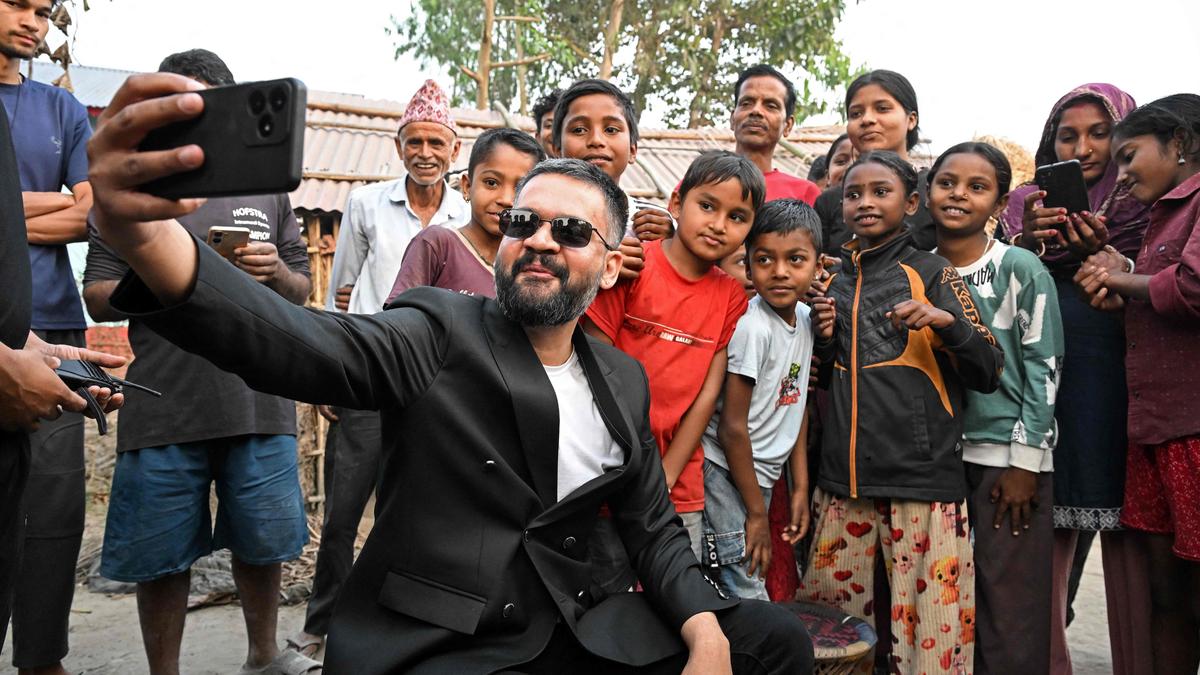
The era of the "three-headed monster"—the endless rotation of Deuba, Oli, and Prachanda—is dead. Nepal’s March 5 general election didn't just shift the furniture; it burned the house down. With the Rastriya Swatantra Party (RSP) securing a staggering 182 seats, Balen Shah is no longer just a rapper or a mayor. He’s the Prime Minister-designate of a nation that has finally run out of patience.
You don't get a mandate like this by being "another politician." You get it because the youth of this country decided that school uniforms and Discord servers were better tools for change than the stale ideologies of the 1990s. But winning was the easy part. Now, Balen and his team of technocrats have to actually run a country that’s been hollowed out by decades of cronyism and a "brain drain" that feels more like an arterial bleed.
The Mandate of a Generation That Won't Wait
If you’re looking for why the establishment collapsed, look at the median age in Nepal: twenty-five. This isn't the generation that remembers the 2006 revolution with nostalgia. They remember the 2025 social media ban. They remember the corruption scandals that made headlines while they were applying for visas to Qatar or Dubai because there were no jobs in Kathmandu.
Balen Shah’s strategy of "monastic silence" during the campaign was brilliant. He didn't have to say much because the failures of the old guard shouted for him. By avoiding the usual circus of empty promises, he became a vessel for the country’s collective exhaustion. The RSP isn't just a political party; it's a 182-seat demand for a government that actually functions.
A Fragile Economy in a Global Pressure Cooker
The new leadership inherits a balance sheet that looks okay on paper but is terrifying in reality. Foreign reserves hit a record $22.47 billion earlier this year, but that’s almost entirely built on the backs of migrant workers. Remittances are the only thing keeping the lights on. It’s a parasitic relationship: the state survives by exporting its most valuable resource—its people.
- The Unemployment Crisis: At over 20%, youth unemployment is a ticking time bomb.
- The Middle East Factor: With tensions between Israel and Iran escalating, the safety of 1.7 million Nepalis abroad is now a national security issue.
- The Energy Gamble: Hydropower is the great hope, but it requires massive investment and a grid that doesn't collapse under the weight of red tape.
The RSP has promised a "vibrant bridge" economy, moving away from being a passive buffer between India and China. That sounds great in a manifesto. In practice, it means convincing New Delhi and Beijing that a bunch of political newcomers won't accidentally trip over a geopolitical wire.
Navigating the Giants Without Getting Crushed
Foreign policy in Nepal used to be a game of playing India against China to see who would give more aid. That game is over. The U.S. is more involved than ever, and the regional order is being rewritten by frameworks like the QUAD.
Balen Shah’s team, led by figures like Shishir Khanal, has to prove they aren't "amateurs" on the world stage. India worries about the open border and stability. China wants its Belt and Road projects to actually move. The West wants a democratic partner that isn't a puppet. The new leadership's plan for trilateral economic partnerships is ambitious, but it lacks the "institutional muscle" that the old parties had. They’ll have to build that muscle while the world is watching.
Breaking the Cycle of Corruption
The most immediate test for the new cabinet isn't a trade deal; it's a probe. The RSP campaigned on investigating the assets of public office holders since 1990. If they don't follow through, they’ll lose the street in six months. If they do, they’ll be declaring war on the very bureaucracy they need to govern.
Internal friction is already showing. Reports of disagreements between party chair Rabi Lamichhane and Balen Shah over key portfolios like the Home Ministry suggest that even "new" parties aren't immune to power struggles. If they spend their first 100 days bickering over who gets to control the police, the Gen Z voters who put them there will be back at Maitighar Mandala before the monsoon hits.
What Needs to Happen by June
The honeymoon will be shorter than a Kathmandu power outage. To stay alive, the new government needs to hit these marks immediately:
- Abolish the "Crony" Quotas: End the system where political parties divvy up jobs in universities, hospitals, and the judiciary.
- Digital Governance: Convert the "Discord energy" into a transparent system for government procurement and service delivery.
- The Migrant Safety Net: Establish a proactive, well-resourced task force to manage the evacuation or protection of workers in conflict zones.
- Audit the Past: Launch the promised high-level probe into the assets of the "top leaders" to show the public that nobody is untouchable.
Honestly, the bar is low. People don't expect a miracle; they just expect a government that doesn't treat the national treasury like a private ATM. Balen Shah has the mandate. He has the majority. Now he just has to prove that a rapper can dance with the wolves of the old establishment without getting bitten.
If you want to track the progress of the new administration, keep a close eye on the first budget release in May—it will tell you exactly where their priorities lie.