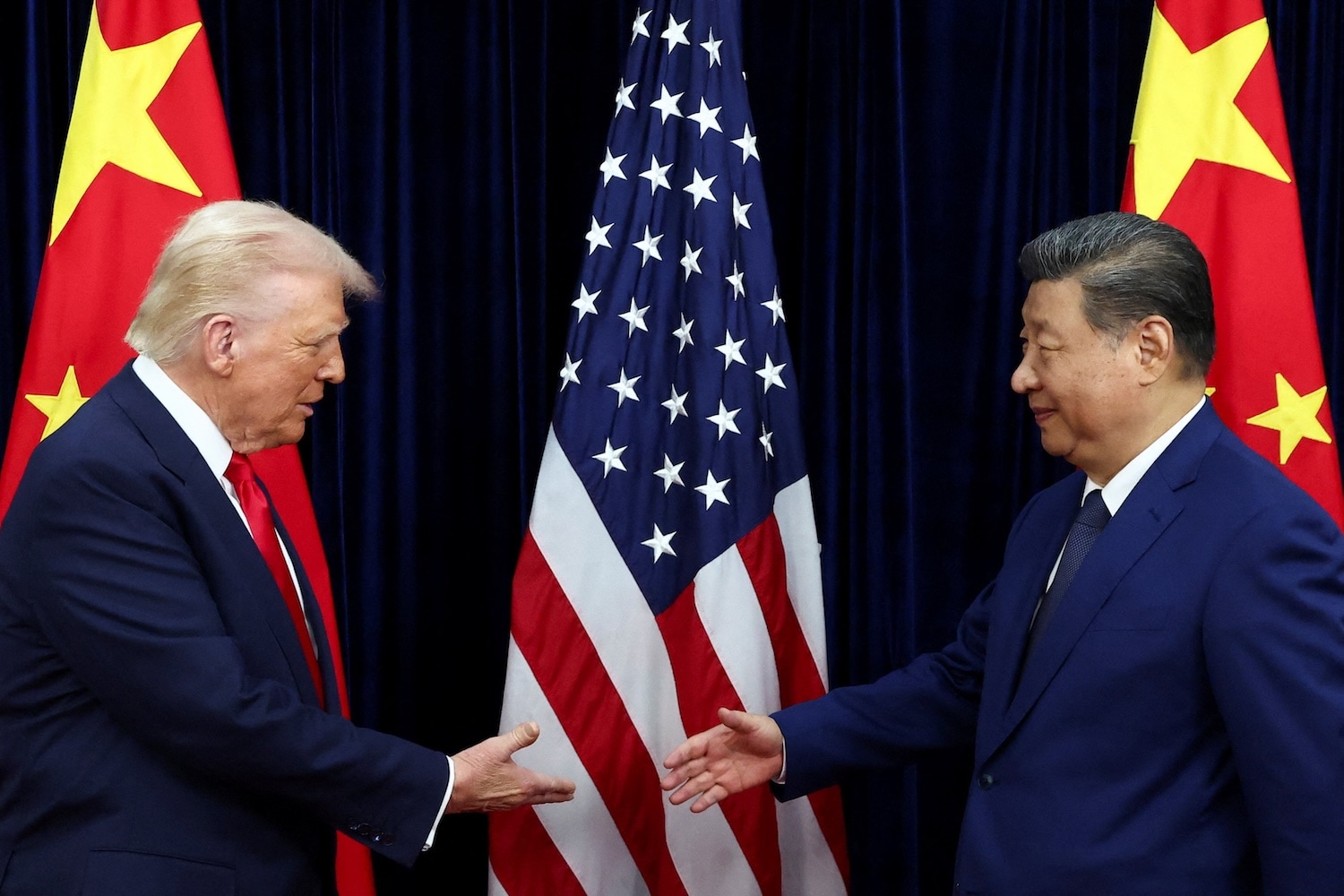
The upcoming congressional delegation to Taipei is not a ceremonial gesture but a calculated injection of friction into the high-stakes negotiation channel between Donald Trump and Xi Jinping. By timing this visit to precede a potential Mar-a-Lago summit, U.S. lawmakers are effectively narrowing the Executive Branch’s "negotiation envelope." This move operates on the principle of Legislative Path Dependency: by reinforcing security and economic commitments on the ground in Taiwan, Congress creates a political and legal baseline that the Trump administration cannot easily trade away in exchange for concessions on trade or fentanyl.
The strategic logic of this visit rests on three structural pillars: the hardware-software decoupling of the global supply chain, the shift from "Strategic Ambiguity" to "Institutionalized Presence," and the preservation of the Taiwan Relations Act (TRA) as a non-negotiable floor for bilateral relations.
The Hardware-Software Decoupling and Semiconductor Sovereignty
The modern definition of Taiwanese security is inseparable from its role as the world's primary foundry. While mainstream analysis focuses on the risk of a kinetic invasion, the more immediate concern for U.S. strategy is the High-End Logic Bottleneck.
- The Foundry Monopoly: Taiwan Semiconductor Manufacturing Company (TSMC) maintains a dominant market share in sub-5nm processes. A blockade or disruption does not just stop "chips"; it halts the iteration cycle of Large Language Models (LLMs) and the production of autonomous defense systems.
- The Logic of Preemption: By visiting Taiwan ahead of a presidential summit, lawmakers are signaling to Beijing that the "Silicon Shield" is backed by a bipartisan commitment that transcends individual presidential terms. This limits Xi Jinping’s ability to frame Taiwan as a secondary issue in a broader trade deal.
- The Technology Transfer Boundary: Lawmakers are likely to use this trip to audit the progress of the CHIPS Act’s "onshoring" requirements. The goal is to ensure that while manufacturing capacity is built in Arizona or Ohio, the R&D and intellectual property remains anchored in a secure, pro-Western democratic framework.
This creates a Binding Constraint on the Executive Branch. If Congress reinforces the "democracy vs. autocracy" narrative through a high-profile visit, the President-elect faces a significantly higher domestic political cost if he attempts to use Taiwan as a "bargaining chip" for a legacy-defining trade agreement.
The Geopolitical Cost Function of the Mar-a-Lago Summit
For the Trump administration, the summit with Xi Jinping is a vehicle for "transactional stabilization." However, the cost function of this stabilization is dictated by the perceived strength of the U.S.-Taiwan relationship. If the U.S. appears to be wavering, Beijing’s "ask" for the summit increases—likely demanding a reduction in arms sales or a public distancing from the current Taipei administration.
The congressional visit serves as a Strategic Counter-Weight. It increases the "entry price" for the summit by demonstrating that any executive-level concessions will face immediate legislative resistance. This is rooted in the Two-Level Game Theory, where a leader’s bargaining power at the international table is strengthened by their domestic inability to yield. By acting as the "hardline" faction, Congress gives the U.S. executive team a "Bad Cop" to reference when Xi asks for concessions on Taiwan.
The Security Architecture: Beyond Kinetic Defense
Security in the Taiwan Strait has evolved from a naval tonnage comparison to a contest of Systemic Resilience. The congressional delegation is expected to focus on three specific vectors of cooperation that go beyond traditional military hardware:
- Asymmetric Denial Capabilities: Moving away from "prestige platforms" (like large frigates or tanks) toward high-volume, low-cost "attrition systems" such as sea mines and mobile anti-ship missiles.
- Information Integrity: Countering "Cognitive Warfare" operations designed to demoralize the Taiwanese public. Lawmakers are increasingly viewing data sovereignty and internet resilience (via low-earth orbit satellites) as critical as missile defense.
- Economic Diversification: Reducing Taiwan's trade dependency on mainland China—which currently serves as a major pressure point for Beijing—by accelerating discussions on the 21st-Century Trade Initiative.
The visit also addresses the Opaque Intentions of the incoming administration. While Trump’s rhetoric often focuses on the "cost" of defense, the presence of veteran GOP and Democratic lawmakers in Taipei reaffirms the "value" of the island as the first link in the First Island Chain. This distinction between "cost-based" and "value-based" foreign policy is where the primary friction between the Hill and the White House will reside.
The Operational Risk of Legislative Grandstanding
While the strategic intent is to bolster Taiwan, there is a legitimate risk of Reactive Escalation. Every high-level visit triggers a standard Chinese "Grey Zone" response: increased sorties across the median line and naval drills that simulate blockades.
The effectiveness of the visit is measured by whether it results in a net increase in Taiwan's security or merely a temporary spike in visibility followed by a more aggressive Chinese posture. To minimize the "Provocation-to-Value" ratio, the delegation must focus on Institutional Durability rather than just optics. This means moving beyond photo-ops to concrete discussions on:
- Backlog Acceleration: Expediting the delivery of the $19 billion in arms already purchased by Taiwan but delayed by U.S. industrial base constraints.
- Cyber Defense Integration: Establishing formal protocols for real-time intelligence sharing on state-sponsored hacking attempts targeting Taiwanese infrastructure.
- Energy Security: Addressing Taiwan's vulnerability to a blockade by discussing LNG strategic reserves and the hardening of the electrical grid.
The Strategic Play: Forcing the Executive Hand
The timing of this visit is a masterclass in Temporal Leverage. By landing in Taipei weeks before a potential Mar-a-Lago meeting, lawmakers are setting the agenda. They are ensuring that the "Taiwan Question" is not a peripheral item on a trade list, but a central, immutable pillar of U.S. strategy.
The strategic recommendation for the U.S. delegation is to frame the visit not as a challenge to the incoming President, but as a reinforcement of his bargaining position. By demonstrating that the U.S. legislative body is fully committed to the status quo, they remove "abandonment" from the list of viable options for both Beijing and Washington.
The play is simple: Solidify the alliance on the ground so that it cannot be liquidated at the negotiating table. The success of the Mar-a-Lago summit will ultimately depend on whether Xi Jinping views the U.S. position as a unified front or a fractured house. This visit, if executed with clinical focus on hardware and economic resilience, ensures the former.