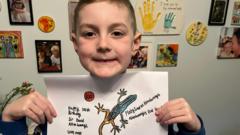
Six-year-old kids usually spend their time chasing cartoons or mastering the art of the temper tantrum. Not Thomas Holt. While other children his age are glued to bright, flashing screens, Thomas has been busy with a self-imposed marathon of creativity that would make a professional illustrator sweat. He just finished his 100th animal drawing. Why? Because Sir David Attenborough turned 98, and Thomas decided a simple card wasn't enough.
This isn't just a story about a cute kid with some crayons. It's a look at how a centenarian broadcaster manages to bridge a nine-decade age gap to turn a primary schooler into a fierce advocate for the planet. Thomas, a pupil from Kent, didn't just scribble a few lions and call it a day. He meticulously researched and drew 100 different species to honor the man who taught him what a pangolin is.
The hundred animal challenge
Thomas started this project with a clear goal. He wanted to celebrate Attenborough’s birthday by showcasing the biodiversity the broadcaster has spent his life protecting. It’s an ambitious task for anyone, let alone someone who still gets excited about loose teeth. The collection is a sprawling mess of color and curiosity. You've got the heavy hitters like elephants and tigers, but Thomas went deeper. He included the obscure stuff. The weird stuff. The creatures that usually only get screen time in the middle of a high-budget BBC documentary.
Most people don't realize how much work goes into a six-year-old’s "project." We're talking about hours of sitting at a kitchen table, tongue poking out in concentration, trying to get the scales on a lizard just right. Thomas’s mother, Jane, watched the whole process. She saw him move from basic shapes to capturing the specific vibe of a blue whale or the jagged posture of a preying mantis. It wasn't about being "perfect." It was about the volume. Finishing 100 drawings takes a level of discipline that many adults lack when they start a new hobby.
Why David Attenborough still hooks the youth
You have to wonder how a 98-year-old man becomes a hero to a child born in 2018. The world is louder now. It’s faster. Yet, Attenborough’s whisper-quiet narration and slow-burn storytelling still land.
He doesn't talk down to kids. That's the secret. When you watch a nature documentary, the stakes are real. Life and death are on the screen. Kids like Thomas respect that honesty. They don't want the sanitized, "everything is fine" version of the world. They want to know why the ice is melting and what happens to the polar bears.
By the time Thomas reached his 100th drawing, he wasn't just an artist. He was a tiny encyclopedia. He can tell you facts about habitat loss that would make a politician squirm. This is the "Attenborough Effect" in its purest form. It moves past entertainment and becomes a core part of a child's identity.
The logistics of a viral tribute
When the news hit that this kid in Kent was drawing his way through the animal kingdom, people noticed. It’s the kind of wholesome content the internet actually deserves. But there’s a deeper layer here regarding how we teach kids about the environment.
Instead of overwhelming them with doom-and-gloom statistics about carbon footprints, we should be giving them pencils. Thomas learned more about biology by trying to draw a hammerhead shark than he ever would have from a dry textbook. He had to look at the anatomy. He had to understand how the animal moves.
What we can learn from Thomas
- Action beats anxiety. Instead of worrying about the planet, he did something tangible.
- Consistency is key. One drawing a day or ten in a weekend, he kept the momentum.
- Inspiration is ageless. Heroes don't have to look like you or live like you.
The drawings were eventually sent off, a bulky package of paper and passion destined for the desk of the world’s most famous naturalist. Sir David has a reputation for actually replying to his fan mail, often with hand-written notes that recipients treasure for decades. Whether or not a reply comes, the impact on Thomas is already permanent.
Beyond the drawing board
If you think this ends with a hundred pictures, you’re wrong. This is how lifelong careers in science and conservation start. Jane mentioned that Thomas now talks about being a "nature explorer" when he grows up. He’s not thinking about fame or money. He’s thinking about the animals he drew and how he can see them in the wild one day.
It’s easy to be cynical about the state of the world. It’s easy to look at the climate crisis and feel like a few drawings don't matter. But they do. They matter because they represent a shift in how the next generation perceives their responsibility to the earth. Thomas isn't an outlier; he's a bellwether.
If a six-year-old can commit to a 100-piece art project to honor a man who speaks for the trees, maybe the rest of us can find a little more discipline in our own lives. We don't all need to be artists. We just need to pay attention.
Go find a local conservation group. Donate to a wildlife trust. Or, honestly, just sit down and watch a documentary with a kid. See the world through their eyes for a second. You might find that the planet is still worth a hundred drawings and a whole lot more.