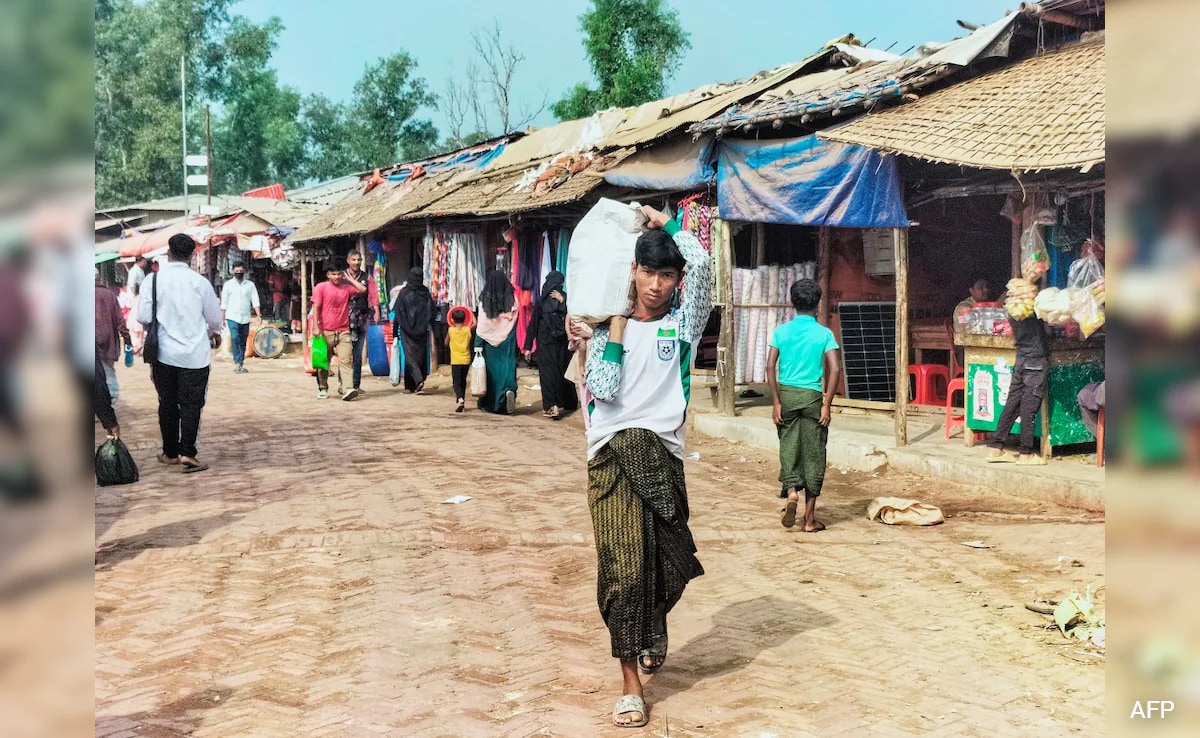
The plastic bag is yellow, or it used to be. Now it is the color of the dust that kicks up from the dry veins of the Cox’s Bazar hills, a faded, sun-bleached ghost of a container. Inside, there are a few handfuls of rice. Not enough to fill a pot. Certainly not enough to quiet the rhythmic, hollow ache in a child’s midsection.
Hamida holds the bag like it is made of spun glass. She knows the math of survival better than any economist in Geneva or New York. In the camps of Bangladesh, life is measured in cents and kilocalories. When the World Food Programme (WFP) announced that the monthly ration would drop from $12 to $10, and then, for some, even lower, it wasn’t just a budget adjustment. It was a subtraction of life. Meanwhile, you can explore related events here: The Calculated Silence Behind the June Strikes on Iran.
Twelve dollars. That is roughly forty cents a day. Try to build a day out of forty cents. Now try to do it with thirty-three.
The world is moving on. The headlines have shifted to newer craters, fresher blood, and more "strategic" geopolitical shifts. But for nearly a million Rohingya refugees, the silence of the international community is a physical weight. It is the sound of a stove not being lit. To explore the complete picture, we recommend the recent report by The Guardian.
The Invisible Math of Starvation
To understand the crisis, you have to look past the sprawling sea of bamboo and tarpaulin. You have to look at the blood. Doctors in the camps are seeing the shift already. When calories disappear, the body begins to consume itself. First, the fat stores go. Then, the muscle. Finally, the mind slows, dulled by the relentless fog of malnutrition.
Statistics are cold. They tell us that funding gaps have reached hundreds of millions of dollars. They tell us that the 2024 Joint Response Plan is struggling to meet even half of its targets. But statistics don't feel the dizziness that hits a mother when she stands up too fast because she gave her portion of lentils to her seven-year-old.
Consider a hypothetical family: let’s call them the Begums. They fled the fire and the boots in Rakhine State in 2017. They arrived with nothing but the clothes on their backs and the trauma etched into their retinas. For years, the $12 voucher was their heartbeat. It bought rice, vegetable oil, and salt. It was a thin, fragile floor, but it kept them from falling into the basement of absolute despair.
Then the cuts came.
When the ration drops by two dollars, the first thing to go is the protein. No more eggs. No more small dried fish. The diet becomes a monotonous, white expanse of carbohydrates. Rice. Just rice. But the human body cannot run on starch alone. Scurvy, anemia, and stunted growth are not "risks" here; they are the current reality. Over 40 percent of children in these camps are already stunted. Their futures are being physically shortened by a ledger somewhere in a distant capital.
The Geography of Desperation
The camps are a pressure cooker. When you take food away from people who are legally forbidden to work, you create a vacuum. Nature, and human desperation, abhors a vacuum.
Men sit in the shade of their huts, their hands idle and their eyes restless. Without the ability to provide, the social fabric begins to fray. We see the rise of "negative coping mechanisms"—a sterile, academic phrase for things that are visceral and violent. It means child marriage, where a daughter is married off not for love, but so there is one less mouth to feed. It means human trafficking, where the promise of a job in Malaysia or Indonesia becomes a siren song that leads to a rickety boat in the middle of the Andaman Sea.
The "funding shortfall" isn't a line item. It is a catalyst for crime. Armed groups and gangs find easy recruits among the hungry. When a young man has no food and no future, a weapon and a small stipend look like a career path. The security of the entire region is being traded for a few million dollars in savings. It is a catastrophic bargain.
The Logic of the Forgotten
Why is this happening? The explanation is usually "donor fatigue." It is a tired phrase. It suggests that the world is a person sitting on a couch, bored of a long-running show. But this isn't entertainment.
The global economy has been bruised by a pandemic and scorched by the war in Ukraine. Grain prices spiked. Fuel costs soared. The cost of delivering a ton of food to a refugee camp skyrocketed at the exact moment that donor nations decided to tighten their belts. It is a perfect storm of apathy and inflation.
But the Rohingya are caught in a unique trap. Unlike refugees in Europe, they cannot integrate. They cannot legally seek employment in Bangladesh. They are tethered to the aid. When that aid is cut, they aren't being asked to "do more with less." They are being asked to exist on nothing.
Imagine the irony of a world that spends billions on artificial intelligence and space tourism but cannot find the change under the cushions to keep a million people from developing night blindness. We are witnessing a slow-motion experiment in human endurance.
The Body Remembers
If you walk through the narrow alleys of Kutupalong, you don't hear much shouting. Hunger is quiet. It is a lethargic, heavy thing. You see it in the way the children play—or rather, the way they don't. They sit. They watch. They wait for the next distribution cycle, which seems to move slower every month.
The psychological toll is perhaps the most difficult to quantify. To be a refugee is to be in a state of permanent "waiting." You wait for a repatriation that never comes. You wait for a justice system that ignores you. And now, you wait for a bowl of rice that might be smaller than the last one.
This constant state of cortisol-soaked uncertainty does something to the brain. It erodes the ability to hope. When you are focused entirely on the next meal, you cannot think about education. You cannot think about rebuilding a society. You are reduced to your most animal instincts.
The Moral Calculus
We often talk about "humanitarian aid" as if it were a gift, a voluntary act of kindness. But there is a deeper question of debt. These are people who were driven from their homes by a genocidal campaign. They are survivors of crimes against humanity. To withhold food from a survivor is a secondary trauma. It is an admission that their lives are a luxury the world can no longer afford.
The funding gap is approximately $100 million for the food sector alone. To a single person, that is an astronomical sum. To the global community, it is a rounding error. It is less than the cost of a single high-end fighter jet. It is less than the opening weekend of a summer blockbuster.
We are choosing this.
Every time a budget is passed that neglects the Rohingya, a choice is being made. We are choosing to let the bags turn from yellow to grey. We are choosing to let the children grow up shorter, weaker, and angrier.
Hamida ties the top of her bag. She has enough for tonight. She will boil the rice until it is a thin porridge, stretching the grains as far as the water will allow. She will tell her children that she isn't hungry, a lie as old as motherhood itself.
The sun sets over the hills, casting long, jagged shadows across the plastic city. The smoke from a thousand small fires rises into the air, but the smell of cooking is faint. There is no meat. There is no fat. There is only the steam of survival.
Tomorrow, the math begins again. The bag will be lighter. The hunger will be sharper. And the world will still be looking the other way.
Somewhere in the distance, a child starts to cry, then stops. Even crying takes more energy than they have to give.
The bowl is empty. The silence is loud.