The Strategic Calculus of Mockery
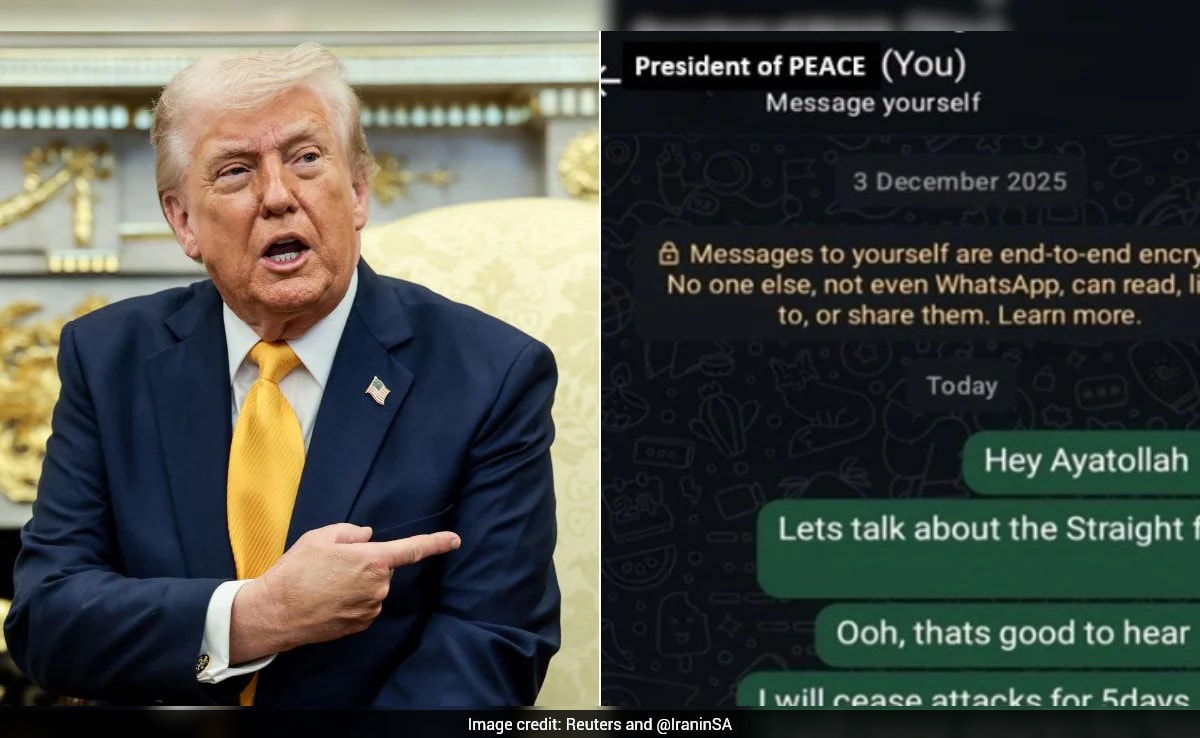
Diplomatic communication between the United States and the Islamic Republic of Iran has transitioned from traditional back-channel negotiations to a high-stakes environment of digital information warfare. When Donald Trump claimed "good and productive talks" with Iranian officials, the subsequent Iranian response—releasing a fabricated WhatsApp conversation—was not merely a crude joke. It represented a calculated deployment of asymmetric information signaling designed to achieve three specific strategic objectives: domestic consolidation, the preservation of negotiating leverage, and the systematic erosion of the adversary's credibility.
In the context of international relations, "credibility" functions as a currency. By utilizing a satirical medium to refute a serious diplomatic claim, Tehran attempted to devalue that currency. This tactic bypasses formal denials, which often inadvertently validate the original claim by treating it as a serious topic of debate. Instead, by framing the claim as "absurd" through parody, the responder seeks to move the initial statement from the realm of "disputed fact" to the realm of "obvious fiction."
The Architecture of the Fabricated Chat
The choice of a fake WhatsApp screenshot as the vehicle for this rebuttal is significant due to its technical and psychological properties. WhatsApp remains a primary communication tool in the Middle East and among the Iranian diaspora, making the medium inherently relatable to the target audience. The "leak" serves as a meta-commentary on the nature of modern diplomacy, where private digital interactions are often weaponized.
Component Analysis of the Signal
The fabrication relied on three specific triggers to maximize its impact:
- Linguistic Contrast: By juxtaposing formal diplomatic jargon with the informal, often emoji-heavy interface of a messaging app, the Iranian side highlighted what they perceive as the "unseriousness" of the American approach.
- Visual Accessibility: A screenshot is more "shareable" than a formal press release. In the attention economy of social media, the visual shorthand of a chat bubble carries more weight than a 500-word denial from the Foreign Ministry.
- Plausible Absurdity: The content of the fake chat was designed to be so outlandish that no observer could mistake it for a real leak, yet it mirrored the specific talking points (e.g., "productive talks") that the Trump administration had been promoting.
Information Asymmetry and the Verification Gap
The effectiveness of this maneuver hinges on the "First-Mover Advantage" in narrative setting. When a high-profile leader makes a claim about a closed-door meeting, they create an information vacuum. In the absence of a third-party observer, the public is forced to choose between two conflicting testimonies.
Iran’s use of satire exploits a psychological loophole: humans are more likely to remember a vivid, humorous correction than a dry, factual one. This is a manifestation of the Illusory Truth Effect, where the repetition of a narrative makes it seem true, but it is countered here by the Von Restorff Effect, which suggests that an item that "stands out like a sore thumb" is more likely to be remembered. By making their denial "sore" and "humorous," the Iranian state ensures their version of events survives the 24-hour news cycle.
The Cost Function of Digital Diplomacy
Engaging in state-sponsored mockery is not without its risks. For Iran, the "Cost Function" of this strategy involves a trade-off between short-term narrative control and long-term diplomatic standing.
- Risk of Devaluation: Continuous use of satire can make a state appear "rogue" or "unprofessional," potentially alienating European or Asian partners who prefer traditional diplomatic norms.
- The Blowback Factor: Once a state validates "faking" content—even for satire—it weakens its own ability to cry "fake news" when it is the victim of a genuine disinformation campaign.
- Audience Segmentation: The message that plays well to a hardline domestic base in Tehran may be interpreted as a sign of weakness or desperation by Western financial markets, impacting the rial's stability.
Tactical Decoupling of Public and Private Channels
A critical oversight in standard reporting on this event is the failure to distinguish between public-facing posture and private-sector pragmatism. States frequently use aggressive public rhetoric to mask quiet, pragmatic concessions. In this instance, the mockery of the "good talks" claim serves as a firewall. It allows the Iranian leadership to maintain a stance of "Maximum Resistance" for its domestic audience while leaving the actual door for negotiation cracked open—provided those negotiations remain genuinely private.
The "WhatsApp" incident suggests that the Iranian side felt the Trump administration had violated the sanctity of private talks by publicizing them prematurely or inaccurately. When one party uses "private" progress as "public" political capital, the other party is incentivized to destroy the value of that capital.
The Verification Bottleneck
This incident highlights a growing bottleneck in geopolitical analysis: the inability to verify digital interactions between high-level officials. We are entering an era where:
- Direct Communication is Opaque: Leaders can communicate via encrypted apps, bypassing traditional diplomatic cables and the oversight of their own state departments.
- Forgery is Trivial: Tools to generate realistic-looking chat logs, deepfake audio, and synthetic video are now accessible to mid-level intelligence officers.
- The Burden of Proof is Inverted: In the past, a state had to prove a meeting happened. Today, because of the prevalence of "leaks," states often find themselves in the impossible position of having to prove a meeting did not happen.
Systematic Response Framework
To neutralize the impact of state-sponsored mockery and digital disinformation, the following structural changes in diplomatic communication are required:
- Standardized Joint Statements: Adopting a rigid protocol where no unilateral claims about "progress" are made without a pre-agreed joint communique. This removes the incentive for the other side to "de-bunk" the claim via satire.
- Cryptographic Verification of Official Logs: While unlikely in the current climate, the use of blockchain or digital signatures to verify the authenticity of official "leaks" would prevent the saturation of the media environment with low-quality forgeries.
- Narrative Resiliency Training: Intelligence and diplomatic corps must be trained to recognize the "Satire-as-Denial" framework, ensuring they do not overreact to what is essentially a rhetorical device.
The Iranian mockery of the "good talks" claim was not a random act of social media trolling. It was a sophisticated application of Asymmetric Signal Disruption. By recognizing the underlying logic of these digital skirmishes, analysts can better predict when a state is preparing for genuine negotiation and when it is simply engaging in narrative defense. The primary strategic takeaway is clear: in the modern era, a "productive talk" that is publicized without bilateral consent will almost certainly be weaponized by the counter-party to preserve their domestic legitimacy.
Establish a "Non-Disclosure Baseline" for all initial-stage diplomatic contacts. If a leader or administration seeks to utilize the mere fact of a meeting as a political victory before tangible outcomes are reached, they must budget for the "Mockery Tax"—a predictable and often effective counter-move by the adversary designed to neutralize that political gain. This requires a shift from "Headline Diplomacy" to "Outcome-First Diplomacy," where the narrative is only released once the cost of a denial exceeds the benefit of the lie.