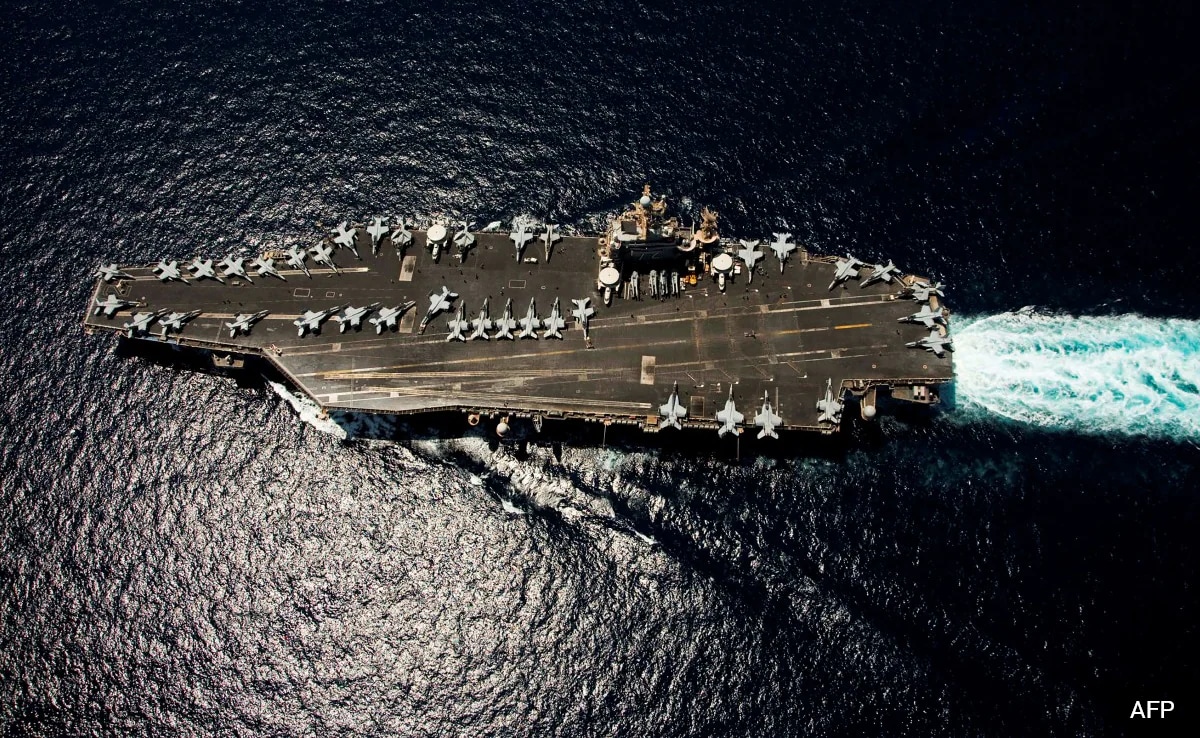
The headlines looked like the start of World War III. On November 12, 2024, Houthi rebels in Yemen—acting as a clear proxy for Iranian military interests—claimed they launched a sophisticated, multi-pronged attack on the USS Abraham Lincoln. They didn't just claim a "strike." They claimed a victory. According to their spokesperson, Yahya Saree, they used cruise missiles and drones to target the massive American aircraft carrier while it was navigating the Arabian Sea.
It sounds terrifying. A billion-dollar symbol of American power under fire by high-tech Iranian weaponry. But if you look at the actual data and the silence from the Pentagon regarding damage, a much different story emerges. This isn't just about a missile launch. It's about a massive information war where the "truth" depends entirely on which satellite feed you're watching.
What actually happened in the Arabian Sea
The Houthis claimed they carried out two separate operations. The first allegedly targeted the USS Abraham Lincoln with several cruise missiles and drones. They said they caught the Americans preparing for an air raid against Houthi positions in Yemen and "foiled" the plan. The second operation supposedly targeted two U.S. destroyers in the Red Sea.
The Pentagon's response was blunt. Major General Pat Ryder confirmed that the destroyers were indeed attacked by at least eight one-way attack drones, five anti-ship ballistic missiles, and three anti-ship cruise missiles. However, he was very clear about one thing: the ships weren't hit. Not once. Even more telling was his statement about the Abraham Lincoln. He noted he wasn't aware of any attack against the carrier itself.
Think about that for a second. We have one side claiming they chased a carrier out of the region and another side saying, "We didn't even see a missile near the big boat."
Someone is lying.
The gap between Iranian claims and carrier reality
Aircraft carriers are the most heavily defended moving objects on the planet. To hit the USS Abraham Lincoln, a missile has to bypass a "layered defense" system that would make a bank vault look like a screen door. You've got the Aegis Combat System on the escorting destroyers. You've got the E-2D Hawkeye planes circling overhead to spot incoming threats from hundreds of miles away. You've got the Phalanx Close-In Weapon System (CIWS) that spits 4,500 rounds of tungsten bullets per minute at anything that gets too close.
Iran and its proxies know they probably won't sink a carrier. They aren't stupid. But they also know that they don't have to sink it to win the news cycle. If they can force a carrier to change course or burn through millions of dollars in interceptor missiles to stop a $20,000 drone, they count that as a win.
Why the Houthi narrative is failing the sniff test
- No Visual Evidence: In 2024, everyone has a camera. If a cruise missile had impacted or even exploded near a carrier, we'd see grainy cell phone footage from sailors or satellite imagery within hours. We saw nothing.
- Operational Continuity: The Abraham Lincoln didn't limp back to port. It stayed on station. Carriers don't "shrug off" cruise missile hits. They are floating cities filled with jet fuel and explosives. A hit would be obvious.
- The "Success" Claim: The Houthis claimed the attack lasted eight hours. If the U.S. Navy was under a sustained eight-hour assault, the response wouldn't just be a press release. It would be a scorched-earth campaign against every launch site in Yemen.
The technical prowess of Iranian cruise missiles
We shouldn't dismiss the hardware, though. Iran has made massive leaps in missile technology. They've moved past old Soviet knock-offs. The missiles provided to the Houthis, like the Quds series, are legitimate threats. These are low-flying, GPS-guided weapons that can be hard to track because they hide in the "clutter" near the surface of the water.
The Quds-3 and Quds-4 missiles have ranges that exceed 800 miles. They're small. They're maneuverable. While they didn't hit the Lincoln this time, the fact that they're being fired at all shows a level of boldness we haven't seen in decades. It shows that the "deterrence" the U.S. hoped to establish in the region is currently broken.
Why the US Navy is playing it cool
The U.S. military strategy right now is "de-escalation through silence." If the Pentagon acknowledges every close call, it gives the Houthis exactly what they want: validation. By downplaying the events or flat-out denying the attack on the carrier occurred, the U.S. robs the Iranian propaganda machine of its fuel.
But there’s a risk here. If the U.S. continues to intercept these missiles without a decisive blow to the command structures in Yemen (and by extension, the advisers from the Islamic Revolutionary Guard Corps), the "Law of Large Numbers" eventually kicks in. You can intercept 99 missiles. But the 100th one only has to be lucky.
The logistics of a carrier strike
Attacking a carrier isn't just about pointing a missile south and hitting "fire." You need a "kill chain."
- Find: You need to know exactly where the carrier is in a massive ocean.
- Fix: You need real-time coordinates because the carrier is moving at 30+ knots.
- Track: You need to keep eyes on it as the missile flies.
- Target: The missile’s seeker has to lock onto the ship specifically.
- Engage: You have to survive the interceptors.
- Assess: You need to see if you actually hit it.
The Houthis struggle with the "Fix" and "Track" parts. Without high-end satellite surveillance or maritime patrol aircraft, they're basically firing at where they think the ship is. This explains why so many of these "attacks" result in missiles splashing harmlessly into the sea miles away from their intended target.
What this means for global shipping and security
The Red Sea and the Gulf of Aden are the arteries of global trade. When Iran claims it can hit a carrier, every insurance company in London spikes its rates. This is economic warfare disguised as a military skirmish.
You should expect more of this. As the conflict in Gaza and the broader tensions between Israel and Iran fluctuate, the maritime front will remain the primary stage for Iranian "strength" displays. They'll keep claiming hits. The U.S. will keep claiming misses.
Identifying the next steps in the region
The situation isn't going to fix itself through "monitoring." If you're following this, look for these specific shifts in the coming weeks:
- Increased B-52 Sorties: Watch for heavy bomber movements into the CENTCOM area. This is the traditional U.S. "stop it" signal.
- Carrier Rotations: The USS Abraham Lincoln has been on a long deployment. Watch for its relief. If it leaves without a replacement immediately on station, it signals a temporary tactical retreat to avoid "cheap shots" from the coast.
- Cyber Retaliation: Most U.S. responses to these claims aren't kinetic. Watch for reports of "technical glitches" in Iranian port authorities or missile command centers.
The "attack" on the USS Abraham Lincoln was almost certainly a failure in a military sense, but as a piece of psychological warfare, it worked perfectly. It got people talking. It made the world's most powerful Navy look, if only for a moment, vulnerable. Don't fall for the hype, but don't ignore the hardware either. The missiles are real, even if the "hits" are a fantasy. Keep a close eye on the official USNI (U.S. Naval Institute) News reports for verified ship movements, as they're the only ones consistently cutting through the noise.